RAG & Knowledge AI
 White-Label & Dedicated Teams - Offshore developers, maintenance and agency support
Headless CMS - Sanity, Payload, Storyblok, Prismic, Contentful, Strapi and Next.js
AI Solutions - AI agents, chatbots, automation and machine learning
WordPress & WooCommerce - Custom themes, plugins and online stores
Shopify & eCommerce - Shopify, BigCommerce, PrestaShop and Webflow builds
HubSpot CMS - Custom themes, modules and integrations
Custom Web Development - PHP, Laravel, CodeIgniter, CakePHP, MERN and MEAN
Mobile App Development - iOS, Android, Flutter and React Native
Business Software - CRM, ERP, SaaS and enterprise applications
UI/UX & Frontend - Figma, design systems and pixel-accurate Figma-to-HTML
Answers from your own content
RAG & Enterprise Knowledge AI
Your company’s knowledge is spread across documents, wikis, tickets and inboxes. People spend hours hunting for answers that already exist somewhere.
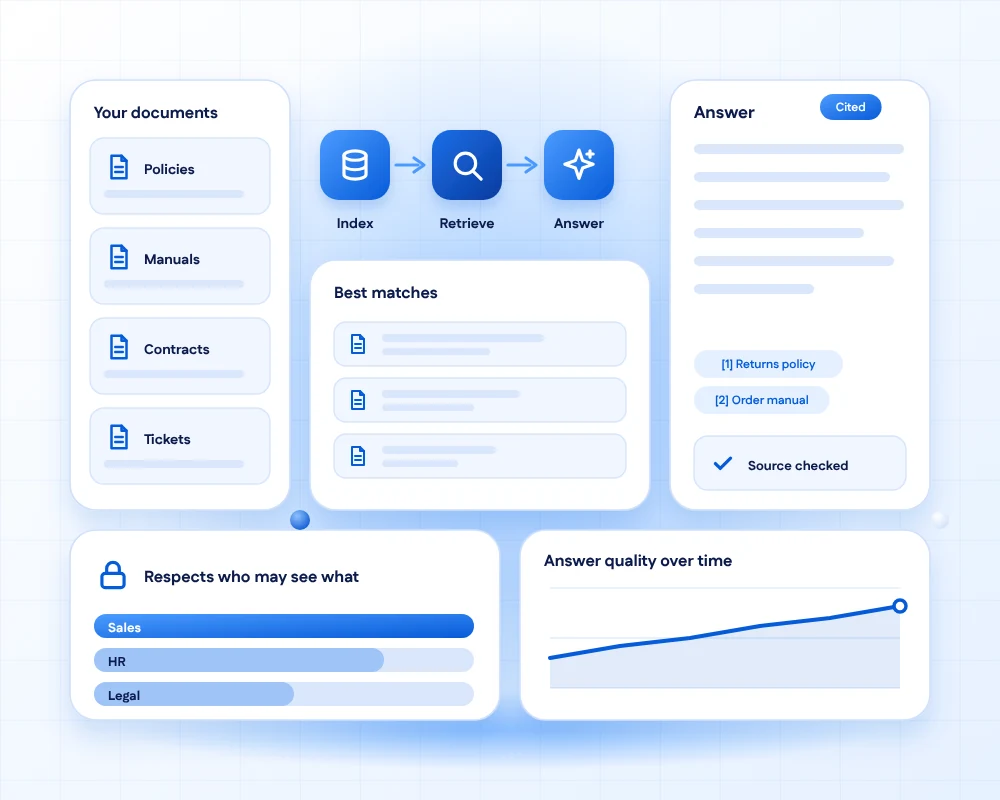
Retrieval-augmented generation finds the right passages and writes a clear answer from them, with citations. We build these systems with access control, up-to-date content and quality that is measured, not assumed.
The result is an assistant your teams and customers can trust, because every answer shows where it came from.
- 11+Years of building business software
- 50+Global long-term clients
- 2,000+Projects delivered
- 24 hrsResponse time on queries
How it works
Five stages from document to answer
Each stage is built and measured on its own.

Prepare
Documents are collected, cleaned and split into passages that make sense on their own.
Ingest
Index
Passages are stored for search by meaning and by keyword, with permissions attached.
Vector + keyword
Retrieve
For each question, the best passages are found and re-ranked, within what the user may see.
Re-rank
Answer
The model writes an answer using only those passages, and cites them.
Generate
Check
The answer is verified against its sources, and low-confidence cases are flagged.
Verify
Where it helps
Knowledge work that gets faster
RAG suits any place where people need accurate answers from a large body of content.
We start with one set of documents and one group of users, prove the value and then expand.

Employee knowledge assistant
Staff ask about policies, products and procedures and get cited answers, instead of searching folders.

Customer support
Support bots and agent tools answer from your latest help content, with sources.

Sales and proposal support
Find past proposals, case studies and product facts, and draft answers to security questionnaires.

Compliance and legal
Search policies, regulations and contracts by meaning, with every answer traceable to a clause.

Engineering and IT
Ask questions of runbooks, tickets and documentation to cut time to resolution.
Customer-facing search
Let customers ask questions of your catalogue, manuals and community content.
Where RAG projects go wrong
The hard parts, handled up front
The model is the easy part. These are not.
Messy source content
Duplicate, outdated and conflicting documents produce confusing answers. We help clean content first and flag what needs fixing.
Permissions
People must only see answers from documents they could open themselves. We carry access rules into the index and the answer.
Tables, scans and images
Many answers sit in PDFs, tables and diagrams. We extract structure so these are searchable.
Freshness
Content changes. We set up automatic updates, so the assistant does not quote last year’s policy.
What we measure
Quality is a number
We agree these measures before building and report on them after launch.
How we work
From one document set to a trusted assistant
Five steps that keep answers honest.
Choose the content
Start with one set of documents and one group of users, where better answers have a clear value.
ScopeWrite the test questions
Collect real questions and the answers experts consider right, before building anything.
Test setBuild the retrieval
Prepare content, build the index, tune search and measure how often the right passage appears.
RetrievalAdd answers and guardrails
Add the model, citations, access control and a safe response when nothing relevant is found.
AnswersLaunch and maintain
Release gradually, review failed questions weekly and keep content and quality up to date.
Operate
Related services
Put grounded knowledge to work
RAG is a building block for many solutions.
FAQs
RAG & knowledge AI questions, answered
RAG, or retrieval-augmented generation, is a method where an AI model first retrieves relevant passages from your own documents and then writes an answer using them. This lets it answer questions about your business without being retrained, and it can cite its sources.
RAG keeps knowledge in your documents, so you can update it instantly, control who sees what and show sources. Fine-tuning changes the model itself, which is slower to update and does not give citations. Many systems use RAG first and add fine-tuning only for style or specialist tasks.
RAG reduces made-up answers by grounding them in your documents, but it does not eliminate them. We require citations, verify answers against sources, tell the model to say when nothing relevant is found and measure correctness on a test set.
We attach access permissions to every passage in the index and filter results by the user’s rights before the model sees anything, so answers never draw on documents the person could not open.
PDFs, Word files, web pages, wikis, tickets, emails, spreadsheets, slides and databases. Scanned documents are read with OCR, and tables and images are handled with extra steps.
Usually some form of vector search helps, often combined with keyword search for exact terms. We choose between managed services, databases you already run and open source options based on your scale and rules.
We design the setup with your security team. Options include keeping everything in your own cloud account, using providers with suitable data terms, or running models inside your environment for stricter needs.
We build a test set of real questions with agreed good answers, then score retrieval, answer correctness and citation accuracy. We track the same measures after launch.
A working prototype on one document set often takes two to four weeks. A production system with permissions, updates and evaluation usually takes two to four months.
We connect to your sources so new and changed documents are re-indexed automatically, and review questions the system could not answer to find content gaps.
Ready for answers from your own documents?
Send us a sample of your content and ten real questions. We will show you how well retrieval-based AI answers them, with sources.