AI-Assisted Legacy Software Modernization
 White-Label & Dedicated Teams - Offshore developers, maintenance and agency support
Headless CMS - Sanity, Payload, Storyblok, Prismic, Contentful, Strapi and Next.js
AI Solutions - AI agents, chatbots, automation and machine learning
WordPress & WooCommerce - Custom themes, plugins and online stores
Shopify & eCommerce - Shopify, BigCommerce, PrestaShop and Webflow builds
HubSpot CMS - Custom themes, modules and integrations
Custom Web Development - PHP, Laravel, CodeIgniter, CakePHP, MERN and MEAN
Mobile App Development - iOS, Android, Flutter and React Native
Business Software - CRM, ERP, SaaS and enterprise applications
UI/UX & Frontend - Figma, design systems and pixel-accurate Figma-to-HTML
Old systems, new life
Legacy Software Modernization
Many companies still run on software that was built years ago. It works, but it is slow to change, hard to connect and expensive to keep alive. Replacing it in one go is risky, and ignoring it gets costlier every year.
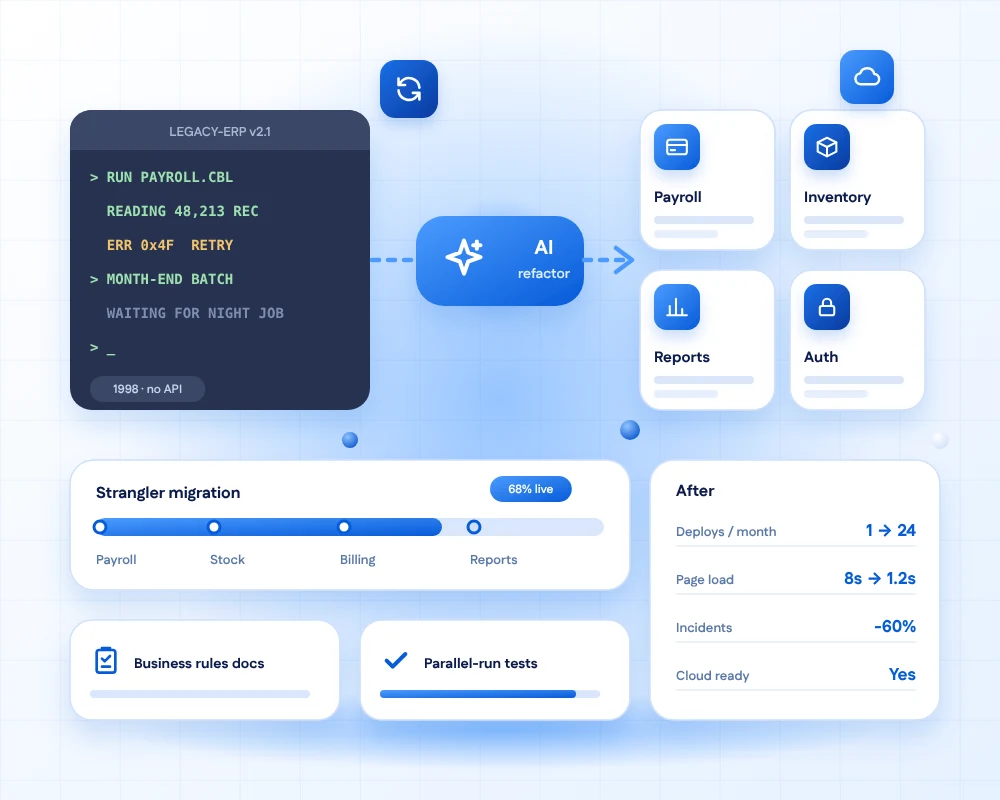
We modernize in slices. We map the system, document what it really does, build tests that lock in today’s behaviour and then replace one capability at a time while the business keeps running.
AI helps us read old code and recover forgotten business rules in a fraction of the time, and our engineers verify everything.
- 11+Years of building business software
- 50+Global long-term clients
- 2,000+Projects delivered
- 24 hrsResponse time on queries
Is it time?
Signs your software needs modernizing
If several of these sound familiar, waiting is probably costing you more than acting.
- Only one person understands itKnowledge lives in a few heads, and the original developers have moved on.
- Changes are slow and riskyA small tweak takes weeks, and every release breaks something unexpected.
- It cannot connect to anythingNo API, so data moves by exports, spreadsheets and retyping.
- The technology is out of supportOld frameworks, databases or servers no longer receive security fixes.
- Hiring is hardFew engineers want, or know how, to work with the technology.
- Costs keep risingMaintenance, workarounds and hosting take more of the budget each year.
Options
Six ways to modernize
We pick the lightest approach that solves the problem, part by part.
| Strategy | What it means | A fit when | Trade-off |
|---|---|---|---|
| Rehost | Move the application as is to new infrastructure or the cloud. | You need a fast exit from an ageing data centre. | Low risk, but the code stays the same. |
| Replatform | Move with small changes, such as a managed database or newer runtime. | The code is sound but the platform is the problem. | Moderate effort and good return. |
| Refactor | Clean up and restructure code without changing what it does. | The system works but is hard to change. | Needs strong tests to keep behaviour identical. |
| Re-architect | Break a monolith into services or modules and add APIs. | You need to scale parts independently or integrate widely. | Bigger change, delivered in slices. |
| Rebuild | Rewrite on a modern stack, using the old system as the specification. | The old code cannot be saved but the business rules matter. | Highest effort, so we phase it. |
| Replace | Retire it and adopt a ready-made product, migrating the data. | A standard product now does the job. | Needs careful data migration and change management. |
Most systems use several strategies at once: rehost one part, refactor another and replace a third.
How we work
A careful path from old to new
Six steps built around proof, not hope.
Assess and map
We inventory applications, dependencies, data and risks, and agree which strategy fits each part.
Week 1 to 3Document what it does
We recover the business rules hidden in old code and databases, and write them down in plain language.
AI-assistedBuild a safety net
Characterisation tests capture today’s behaviour, so we can prove nothing changes by accident.
AI-drafted, engineer-approvedModernize slice by slice
We replace one capability at a time behind a routing layer, a method known as the strangler pattern.
Small releasesRun in parallel
Old and new run side by side, and results are compared before users are switched over.
Low riskRetire the old system
Once the new parts are proven, we switch off the old ones and archive the data.
Clean exit
AI in modernization
Understanding old code in days, not months
AI speeds up the slow, reading-heavy work. People decide what the new system should do.

Code comprehension
AI reads large, poorly documented code bases and explains what each part does and how parts depend on each other.

Rule documentation
Hidden business rules are drafted in plain language for your experts to confirm or correct.

Test generation
Characterisation tests are drafted to lock in current behaviour, then curated by engineers.

Refactoring assistance
Mechanical conversions and clean-ups are accelerated, with every change reviewed and tested.
What improves
How we measure success
Agreed at the start, tracked through the project.
What we modernize
Technologies we work with
A starting point for common legacy stacks.
Mainframe & COBOL
Extract rules, expose APIs and migrate in phases.
Classic ASP & VB6
Move to current .NET or web frameworks.

.NET Framework
Upgrade to modern .NET and containers.

Java monoliths
Modularise and move to supported runtimes.
Old PHP applications
Upgrade to PHP 8 and Laravel with tests.

Delphi & desktop apps
Bring desktop workflows to secure web apps.
Ready to run your modernized system in the cloud?
We design the cloud architecture, set up pipelines and handle operations.
FAQs
Modernization & AI questions, answered
It is the process of updating older business applications so they are secure, maintainable and able to connect to modern systems. That can mean moving them to the cloud, restructuring the code, adding APIs or rebuilding parts on a current technology stack.
Usually not. A full rewrite is slow and risky because it must reproduce years of hidden rules. We prefer to modernize in slices, keeping the system running while we replace parts, and only rebuild what truly needs it.
AI is very good at reading large amounts of unfamiliar code. It helps us understand dependencies, document business rules, draft tests and speed up mechanical conversions. Engineers verify every output, because the old behaviour must be preserved exactly.
Yes. We run old and new systems side by side, switch users over in stages and keep a rollback path, so operations continue throughout.
It is an approach where new services gradually take over functions from the old system behind a routing layer. Over time the old system shrinks until it can be switched off, which avoids a risky big-bang cut-over.
We write characterisation tests that capture how the current system behaves, run old and new in parallel and compare results, and involve your business experts to confirm edge cases.
We work with older PHP, ASP and VB6, .NET Framework, Java, Delphi and desktop applications, and legacy databases. For very specialised platforms such as mainframes we assess early and team up with specialists where needed.
An assessment takes a few weeks. Modernization is delivered in phases, with the first slice often live within a few months. Total time depends on the size and condition of the system.
We rehearse migrations on copies, reconcile record counts and totals, keep backups and plan rollback before touching production data.
Start with a short assessment. We review the system, interview its users, and give you a prioritised plan with options, risks and costs.
Ready to give your software a second life?
Start with a short assessment. We will review your system, explain the options and give you a phased plan with costs and risks.