Computer Vision Development
 White-Label & Dedicated Teams - Offshore developers, maintenance and agency support
Headless CMS - Sanity, Payload, Storyblok, Prismic, Contentful, Strapi and Next.js
AI Solutions - AI agents, chatbots, automation and machine learning
WordPress & WooCommerce - Custom themes, plugins and online stores
Shopify & eCommerce - Shopify, BigCommerce, PrestaShop and Webflow builds
HubSpot CMS - Custom themes, modules and integrations
Custom Web Development - PHP, Laravel, CodeIgniter, CakePHP, MERN and MEAN
Mobile App Development - iOS, Android, Flutter and React Native
Business Software - CRM, ERP, SaaS and enterprise applications
UI/UX & Frontend - Figma, design systems and pixel-accurate Figma-to-HTML
Software that sees
Computer Vision for Real Conditions
People inspect, count and read from images all day: parts on a line, shelves in a store, forms on a desk. It is slow, tiring and varies from person to person.
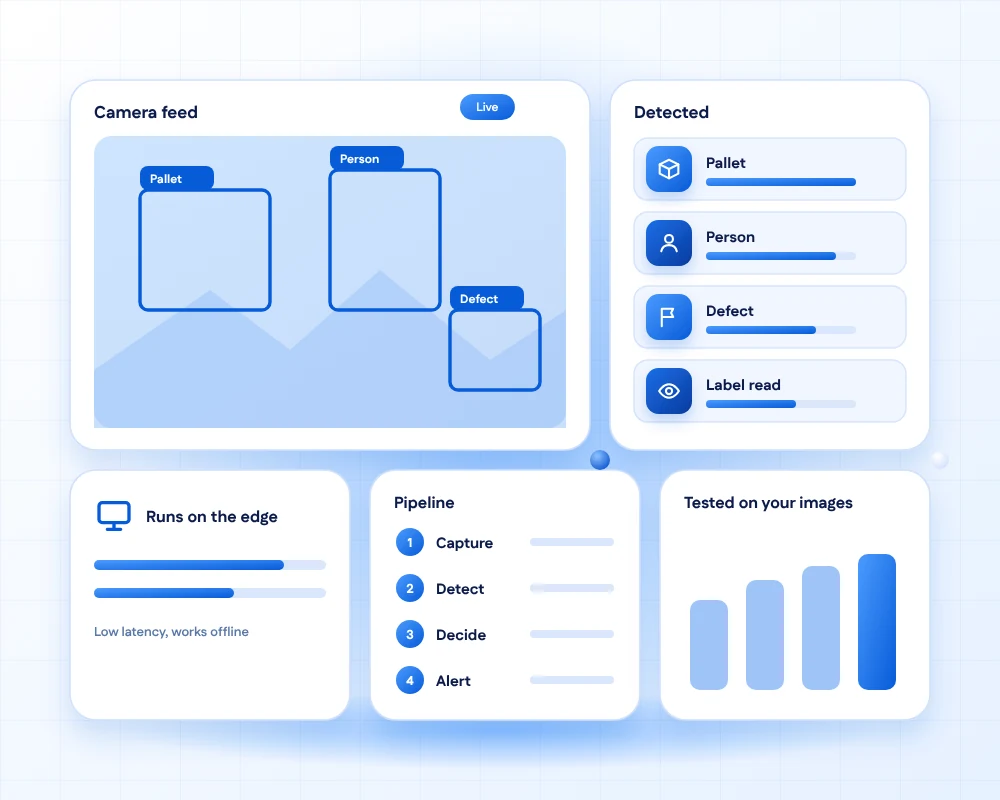
We build computer vision systems that detect, classify, count and read from images and video, and we test them on your own cameras and lighting, not only on tidy sample photos.
They run in the cloud, on the edge next to the camera or on a phone, with uncertain cases passed to a person.
- 11+Years of building business software
- 50+Global long-term clients
- 2,000+Projects delivered
- 24 hrsResponse time on queries
Where it helps
Six places vision pays off
Anywhere people look at many images repeatedly.

Quality inspection
Find scratches, missing parts and print errors on a production line, faster and more consistently than the eye.
Manufacturing
Safety and compliance
Detect missing helmets, people in restricted zones and spills, and alert the right person.
Industrial
Retail and shelves
Count stock, check shelf layout and understand how customers move through a store.
Retail
Document and ID reading
Read invoices, forms, labels and IDs from photos and scans, and check them against records.
Back office
Logistics and yards
Read plates and container numbers, count pallets and check loads on arrival.
Logistics
Health and agriculture
Support review of scans, count plants or spot disease early, with an expert making the decision.
Specialist
What vision can do
Six tasks, one toolbox
Different problems need different techniques. We pick the simplest one that answers your question.
A single project often combines two or three of these.

Classification
What is in this picture? Good or defective, ripe or unripe.

Detection
Where are the objects? Boxes around people, pallets, parts or defects.

Segmentation
Exactly which pixels? Outlines for measuring area, size or coverage.

Reading text (OCR)
Turn printed or handwritten text in an image into data.

Tracking & counting
Follow objects across video frames to count or time them.

Anomaly detection
Spot anything unusual when you only have examples of good items.
Where it runs
Cloud, edge or phone
The choice affects speed, cost, privacy and reliability.

In the cloud
Flexible and easy to update, suited to batch work and uploads, with network delay.

On the edge
Runs next to the camera for instant results, offline use and lower bandwidth.

On a phone
Inspection and scanning in the field, with no extra hardware.
How we work
From your images to a monitored system
Five steps that keep results real.
Look at your images
Review real images and conditions: lighting, angles, speed and the defects that matter.
DiscoveryCollect and label
Gather a representative image set and label it carefully, with experts reviewing the hard cases.
DataTrain and test
Train models and test them on images they have never seen, including the awkward ones.
ModelPilot on site
Run alongside the current process, compare results and tune thresholds.
PilotDeploy and monitor
Integrate with your systems and watch for changes in lighting, products or cameras.
Operate
Quality you can check
What we verify before go-live
The things that separate a demo from a system.
- Real-condition imagesTested on images from your actual cameras, lighting and angles.
- Hard cases coveredRare defects, glare, blur and occlusion are in the test set.
- False alarms and missesWe report both, and tune thresholds to the cost of each mistake.
- Human review pathUncertain detections go to a person, with the image attached.
- Privacy by designFaces and personal data blurred or avoided unless there is a clear need and legal basis.
- Drift monitoringWe watch for changes in products, lighting or cameras and retrain when needed.
Part of a wider machine learning plan?
See how vision fits with prediction, recommendation and MLOps.
FAQs
Computer vision questions, answered
Computer vision is the field of AI that lets software understand images and video. It can classify what is in a picture, find and count objects, read text and measure shapes.
Typical uses include inspecting products for defects, checking safety rules, counting stock, reading documents and labels, and monitoring yards and sites. We look for tasks where people currently look at many images repeatedly.
It depends on the task. Modern pre-trained models can work well with a few hundred labelled images for simple tasks, while rare defects or varied conditions need more. We assess your data and advise early.
It depends on image quality and the task. We measure accuracy on images the model has not seen, from your real setting, and report both missed detections and false alarms so that you can judge the trade-off.
Yes. Edge deployment runs models next to the camera on a small device or industrial computer, giving instant results without sending video to the cloud.
Often standard cameras are enough, but lighting and positioning matter greatly. For inspection we advise on cameras, lighting and mounting, and test before you buy at scale.
We avoid identifying people unless there is a clear need and a legal basis, blur faces where possible, limit storage and follow local rules. We design with your legal and works-council requirements in mind.
Yes. We process video streams to detect, track and count objects over time, with options to alert in real time or report in batches.
A proof of concept on your images often takes four to eight weeks. A production deployment with cameras, integration and monitoring typically takes three to six months.
The aim is to handle the repetitive checking and let people focus on judgement and exceptions. Uncertain items are routed to a person, and their decisions help improve the system.
Ready to see what your cameras could catch?
Send us a few sample images and tell us what you need to detect. We will test them and report honestly on what is achievable.