Ecommerce Migration & Replatforming
 White-Label & Dedicated Teams - Offshore developers, maintenance and agency support
Headless CMS - Sanity, Payload, Storyblok, Prismic, Contentful, Strapi and Next.js
AI Solutions - AI agents, chatbots, automation and machine learning
WordPress & WooCommerce - Custom themes, plugins and online stores
Shopify & eCommerce - Shopify, BigCommerce, PrestaShop and Webflow builds
HubSpot CMS - Custom themes, modules and integrations
Custom Web Development - PHP, Laravel, CodeIgniter, CakePHP, MERN and MEAN
Mobile App Development - iOS, Android, Flutter and React Native
Business Software - CRM, ERP, SaaS and enterprise applications
UI/UX & Frontend - Figma, design systems and pixel-accurate Figma-to-HTML
Move without losing traffic or orders
Ecommerce Migration & Replatforming
Moving a store feels risky, and it is: products, customers, orders, URLs and integrations all have to arrive intact while customers keep buying and search engines keep sending visitors.
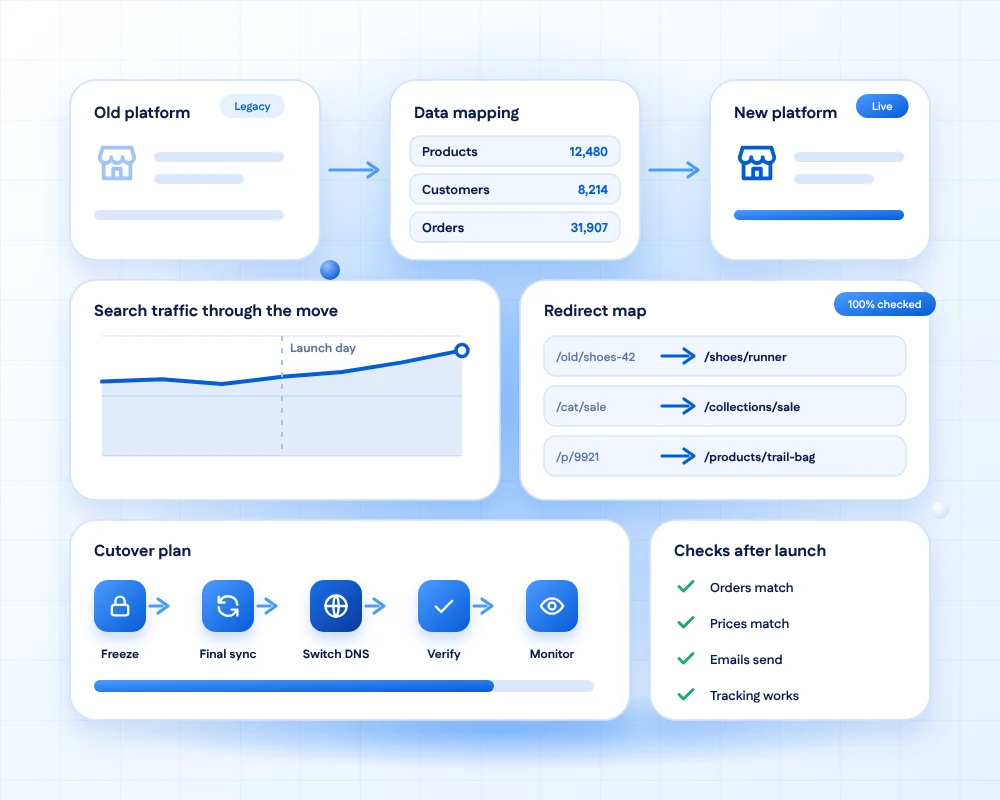
We plan the move around those risks. We audit what you have, map every field and URL, rehearse the whole migration on a copy and cut over at a quiet time, with a rollback plan ready.
Afterwards we watch orders, errors and search traffic closely, so any problem is found in hours, not weeks.
- 11+Years of building business software
- 50+Global long-term clients
- 2,000+Projects delivered
- 24 hrsResponse time on queries
When to move
Six signs it is time
If several of these sound familiar, the platform may be holding you back.

The store is slow and costly to run
Hosting, patches and plugin upkeep take more budget than new features.
Cost
Security and updates worry you
The platform is out of date or hard to upgrade without breaking things.
Risk
Staff fight the admin
Simple jobs such as promotions or product edits need a developer.
Usability
Integrations are fragile
ERP, shipping, marketing and payment connections fail or need manual fixes.
Systems
Growth has hit a ceiling
Traffic spikes, new markets or new channels outgrow what the store can do.
Scale
Conversion is falling behind
Checkout and mobile experience lag behind what competitors offer.
Sales
What we move
Everything that makes the store work
A good migration moves more than the product list. These are the six areas we plan for.
We tell you early what transfers cleanly and what needs a workaround on the new platform.

Products and catalogue
Variants, images, prices, stock, categories, attributes and metadata.
Customers and accounts
Profiles, addresses, consent and groups, with a plan for passwords and logins.

Orders and history
Order history, statuses, refunds and gift or loyalty balances where possible.

Content and pages
Blog posts, landing pages, policies and navigation.

SEO assets
URLs, redirects, titles, descriptions, structured data and sitemaps.
Integrations and tracking
Payments, shipping, ERP, email and analytics, rebuilt and re-tested.
What we measure
A migration is judged by what stays intact
We agree these measures at the start and report on them.
How we work
From audit to a watched launch
Five steps that keep the risk low.
Audit the current store
Inventory data, plugins, integrations, URLs and traffic, and agree what moves, what changes and what stops.
AuditChoose the platform
Compare options against your catalogue, markets, team and budget, and decide with the facts.
DecideBuild and map the data
Set up the new store and map every field from old to new, with sample imports.
BuildRehearse the move
Run the full migration on a copy, compare counts, test orders and fix gaps.
RehearseCut over and watch
Freeze, final sync, switch, verify and monitor orders, errors and search traffic closely.
Launch
Built to be trusted
What we verify before cutover
The checks that protect revenue and rankings.
- Redirect map for every URLOld product, category and content URLs point to the right new pages.
- Counts reconciledProducts, customers and orders match between systems, with exceptions listed.
- Test orders end to endPayment, tax, shipping, email and stock checked before launch.
- Analytics and tags verifiedConversion tracking and ad pixels work from the first live order.
- Rollback planA tested way back, in case something unexpected happens.
- Post-launch monitoringDaily checks of errors, orders and search data for the first weeks.
Platforms we build on
Choose the right destination
We work across the main platforms and recommend on facts.


FAQs
Ecommerce migration questions, answered
Replatforming means moving your online store from one platform to another, for example from Magento or WooCommerce to Shopify, while keeping your products, customers, orders and search visibility.
Common signs are rising running costs, hard-to-maintain integrations, security worries, a slow or dated store or growth that the platform cannot support. We help you weigh the cost of moving against the cost of staying.
It depends on catalogue size, markets, integrations, team skills and budget. Shopify suits many growing brands, WooCommerce suits those who want full control, and other platforms fit specific needs. We compare them with your numbers and do not push one.
Rankings can drop if URLs, content or speed change carelessly. We map every URL, set 301 redirects, keep titles and structured data, and compare traffic before and after. Some short-term movement is common, and we monitor closely.
Usually yes. Customer profiles and order history can be moved, though some platforms handle passwords, gift cards or subscriptions differently. We explain what moves cleanly and what needs a workaround.
Usually not. We rehearse on a copy, then use a short freeze and a final sync at a quiet time so you can keep selling with minimal interruption.
We list every connection, rebuild them for the new platform and test each one: payments, shipping, ERP, accounting, email and analytics.
Yes, and many do. We often suggest moving first and redesigning in a second phase to limit risk, or running both together with clear scope.
A simple catalogue can move in four to eight weeks. Larger stores with many integrations and custom features typically take three to six months.
Yes. We monitor orders and errors closely at first, then continue under a support plan with agreed response times.
Ready to move without the risk?
Tell us which platform you use today and what is holding you back. We will review your store and outline a safe plan, with an honest estimate.