LLM Integration & Fine-Tuning
 White-Label & Dedicated Teams - Offshore developers, maintenance and agency support
Headless CMS - Sanity, Payload, Storyblok, Prismic, Contentful, Strapi and Next.js
AI Solutions - AI agents, chatbots, automation and machine learning
WordPress & WooCommerce - Custom themes, plugins and online stores
Shopify & eCommerce - Shopify, BigCommerce, PrestaShop and Webflow builds
HubSpot CMS - Custom themes, modules and integrations
Custom Web Development - PHP, Laravel, CodeIgniter, CakePHP, MERN and MEAN
Mobile App Development - iOS, Android, Flutter and React Native
Business Software - CRM, ERP, SaaS and enterprise applications
UI/UX & Frontend - Figma, design systems and pixel-accurate Figma-to-HTML
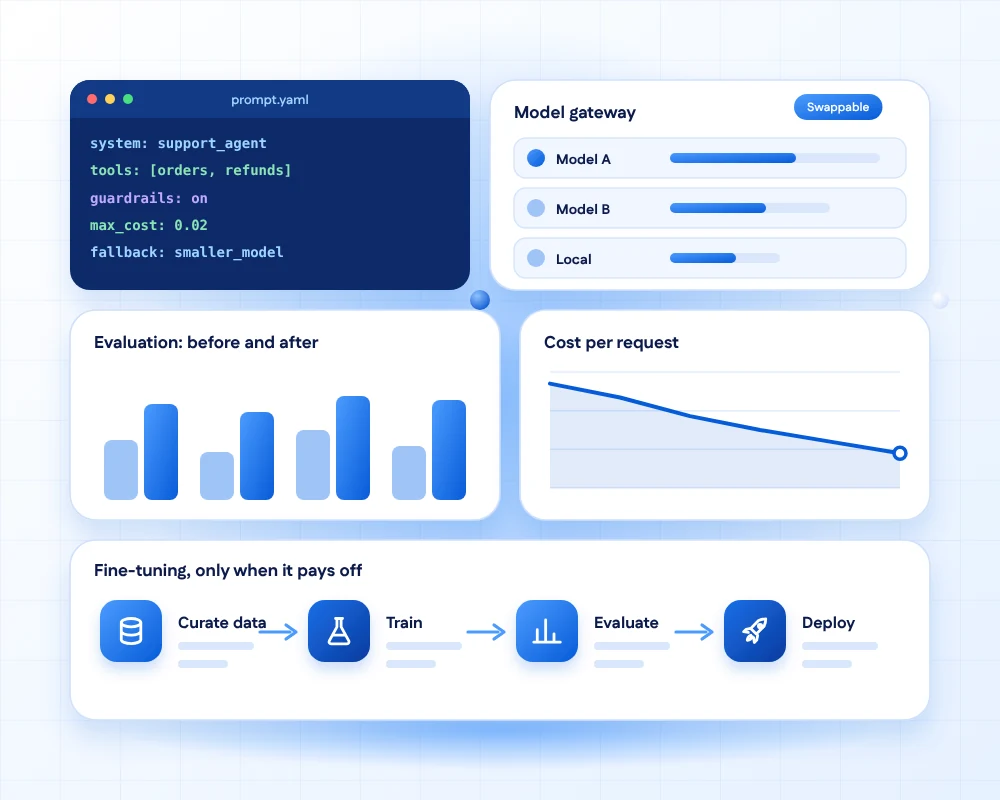
Models you can swap, test and afford
LLM Integration & Fine-Tuning
Calling a language model takes an afternoon. Making it reliable, affordable and safe inside a real product takes engineering: prompts under version control, tests that catch regressions, limits on cost and a way to change models when something better arrives.
We integrate language models through a gateway you control, measure them on your own examples and fine-tune only when it clearly beats the cheaper options.
You end up with an AI feature that keeps working as the models, prices and your needs change.
- 11+Years of building business software
- 50+Global long-term clients
- 2,000+Projects delivered
- 24 hrsResponse time on queries
What proper integration includes
Six parts around the model
The model is one piece. These are the rest.

Model gateway
One layer between your apps and the models, so providers can change without rewriting your software.

Prompt management
Prompts are versioned, tested and reviewed like code, not pasted into the app.

Tools and function calling
The model can look up data and trigger actions through defined, permission-limited functions.

Evaluation
Automated tests score answers on real examples, every time a prompt or model changes.

Cost and latency control
Caching, routing to smaller models and limits keep speed up and spend predictable.

Safety and privacy
Input and output filters, data masking, logging and access control around every call.
Choosing an approach
Prompts, retrieval, fine-tuning or custom?
Start light and climb only when the numbers justify it.
| Approach | Typical time | Relative cost | A good fit for |
|---|---|---|---|
| Better prompts | Hours to days | Low | Formatting, tone, simple tasks and routing. |
| Retrieval (RAG) | Weeks | Medium | Questions that need your own, changing knowledge. |
| Fine-tuning | Weeks to months | Higher | Consistent style or format, specialist tasks, shorter prompts at scale. |
| Custom or open model | Months | Highest | Strict data residency, offline use or very high volume. |
The right answer is often a combination of the first three.
Fine-tuning, done carefully
Tune only when it pays
Fine-tuning is powerful and easy to overuse. These habits keep it honest.

Test before you tune
We measure how far prompts and retrieval get, so you only pay for fine-tuning when it adds real value.

Good data beats more data
A few hundred excellent, reviewed examples often beat thousands of noisy ones.
Compare fairly
Fine-tuned and base models are scored side by side on the same unseen test set.

Plan for change
Models and prices move quickly, so we design for switching and re-training.
How we work
From test set to LLMOps
Five steps that put measurement first.
Define the task and the score
Agree what a good answer looks like and build a test set of real examples.
Evaluation firstIntegrate through a gateway
Connect the model with prompts, tools, logging and limits, behind a layer you control.
IntegrationOptimise
Improve prompts, add retrieval, route simple jobs to cheaper models and cache repeats.
OptimiseFine-tune if it pays
Prepare data, train, evaluate against the base model and ship only if the gain is clear.
Fine-tuningOperate
Monitor quality, cost and latency, test new models safely and keep prompts under version control.
LLMOps
Built to last
What we verify before launch
The details that stop AI features degrading quietly.
- Model-agnostic designSwitching provider is a configuration change, not a rebuild.
- Versioned promptsEvery change is tracked, tested and reversible.
- Regression testsA change that makes answers worse is caught before release.
- Rate limits and budgetsPer-user and per-feature caps prevent runaway cost.
- Data handling reviewWhat is sent, stored and logged is agreed with your security team.
- FallbacksIf a provider is slow or down, the system degrades gracefully.
Need the model to answer from your documents?
RAG grounds a model in your content, with citations and access control.
FAQs
LLM integration questions, answered
LLM integration means connecting large language models to your software, so it can understand and generate text, call your systems and answer questions. Good integration covers prompts, tools, evaluation, cost control and safety, not only the API call.
It depends on the task, quality needed, speed, price and data rules. We test candidate models on your own examples, and design the system so that the model can be changed later.
A model gateway is a layer between your apps and the model providers. It handles routing, logging, limits, caching and filters in one place, so you can switch or mix models without rewriting applications.
Fine-tuning pays off when you need a consistent style or format, a specialist task, or shorter prompts at high volume. It does not add reliable up-to-date knowledge, which is better handled with retrieval. We test the cheaper options first.
Often a few hundred to a few thousand high-quality examples, depending on the task. Quality and consistency matter more than volume, and we help prepare and review the data.
We build a test set of real examples with agreed good answers, score outputs automatically and with human review, and rerun the tests whenever prompts or models change.
We use caching, route simple jobs to smaller models, shorten prompts, set per-user limits and track cost per task, so the bill never comes as a surprise.
Yes. Open models can run in your cloud account or on your own servers when data rules require it. We compare quality and cost against hosted options first.
We mask or remove sensitive fields before sending, control what is logged, choose providers with suitable data terms and, where needed, keep processing inside your environment.
A first integration with evaluation often takes two to six weeks. Fine-tuning projects add data preparation and training time, commonly one to three months in total.
Ready to build on language models properly?
Tell us what the feature should do. We will test candidate models on your examples, estimate running cost and show you what is worth building.