AI Agent Development
 White-Label & Dedicated Teams - Offshore developers, maintenance and agency support
Headless CMS - Sanity, Payload, Storyblok, Prismic, Contentful, Strapi and Next.js
AI Solutions - AI agents, chatbots, automation and machine learning
WordPress & WooCommerce - Custom themes, plugins and online stores
Shopify & eCommerce - Shopify, BigCommerce, PrestaShop and Webflow builds
HubSpot CMS - Custom themes, modules and integrations
Custom Web Development - PHP, Laravel, CodeIgniter, CakePHP, MERN and MEAN
Mobile App Development - iOS, Android, Flutter and React Native
Business Software - CRM, ERP, SaaS and enterprise applications
UI/UX & Frontend - Figma, design systems and pixel-accurate Figma-to-HTML
Software that does the work
AI Agents With Guardrails
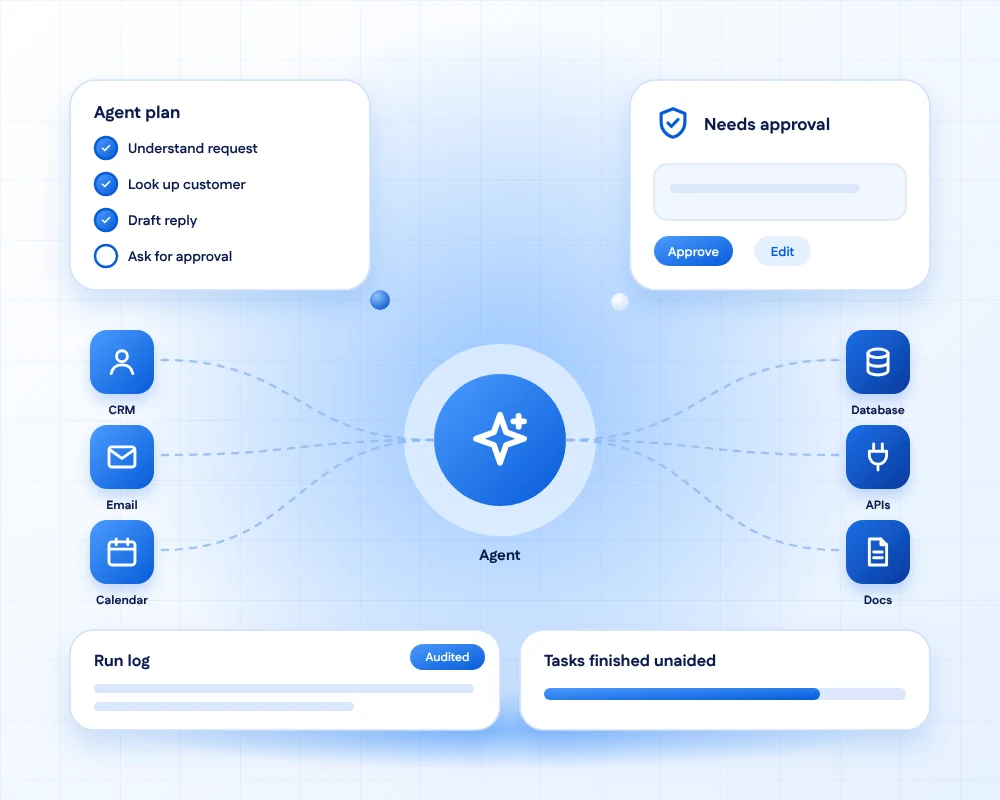
An AI agent does more than answer a question. It plans the steps, uses your tools and gets a task done, whether that is a research brief, a CRM update or a checked invoice.
That power needs boundaries. We build agents with narrow permissions, approval points for risky actions, spending limits and a full audit trail, and we widen their autonomy only as the results earn it.
You get agents your team can supervise and trust, rather than a demo that falls over in production.
- 11+Years of building business software
- 50+Global long-term clients
- 2,000+Projects delivered
- 24 hrsResponse time on queries
How much autonomy
Four levels of agent autonomy
We match the level to the task and the risk, and raise it only when the results justify it.

Assistant
Answers questions and drafts content. A person does the rest.
Lowest risk
Copilot
Suggests the next action inside your tools. A person approves each one.
Low risk
Task agent
Carries out a defined task using tools, within strict limits and with logging.
Moderate risk
Multi-agent system
Several specialised agents share a goal, under a supervisor and human approval points.
Higher risk, more value
Services
Our AI Agent Services
Six kinds of agent we build most often.
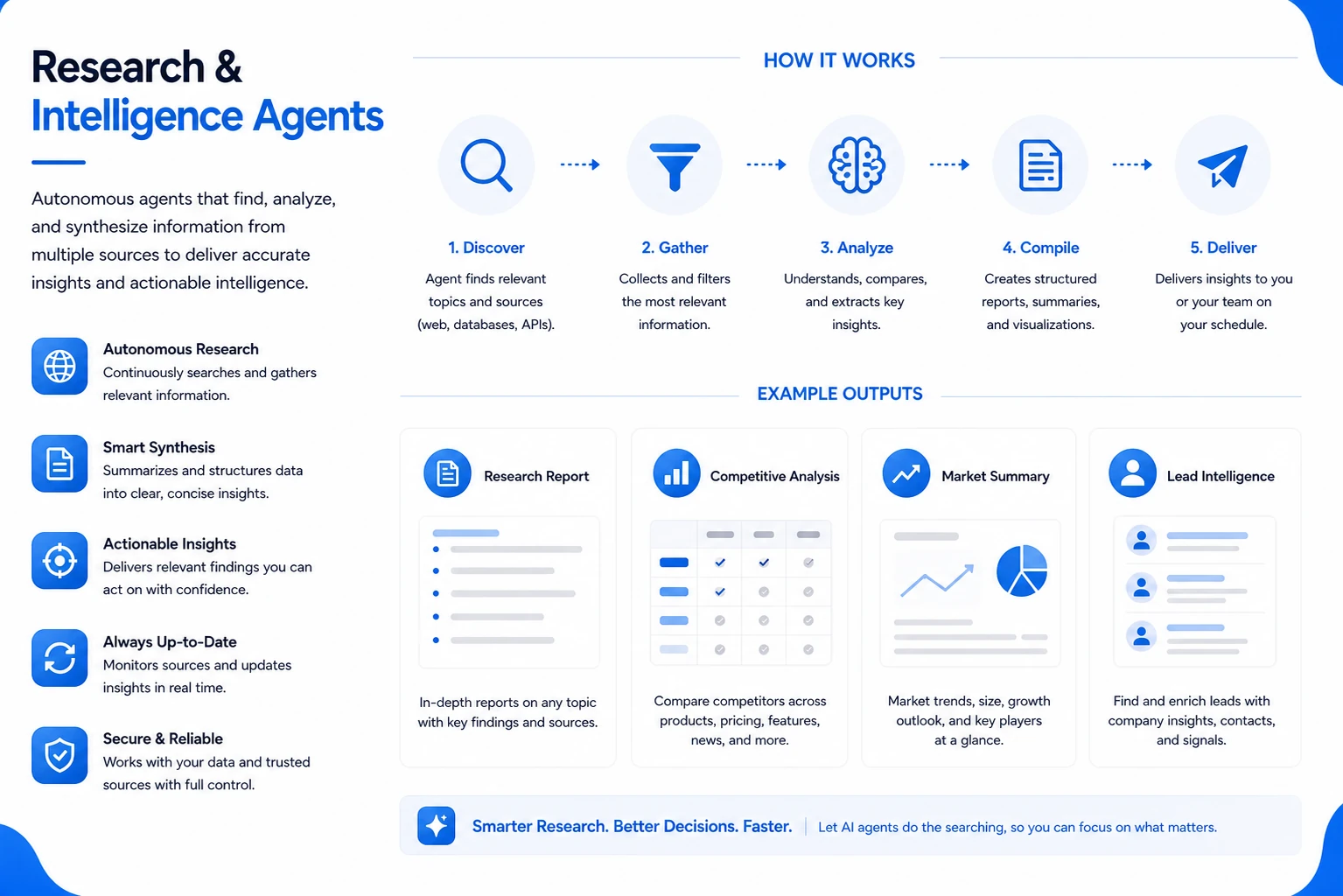
Research & Intelligence Agents
Gather, compare and summarise information from the web and internal sources into a cited brief.
WITH AISources listed for every claim, so the work is checkable.
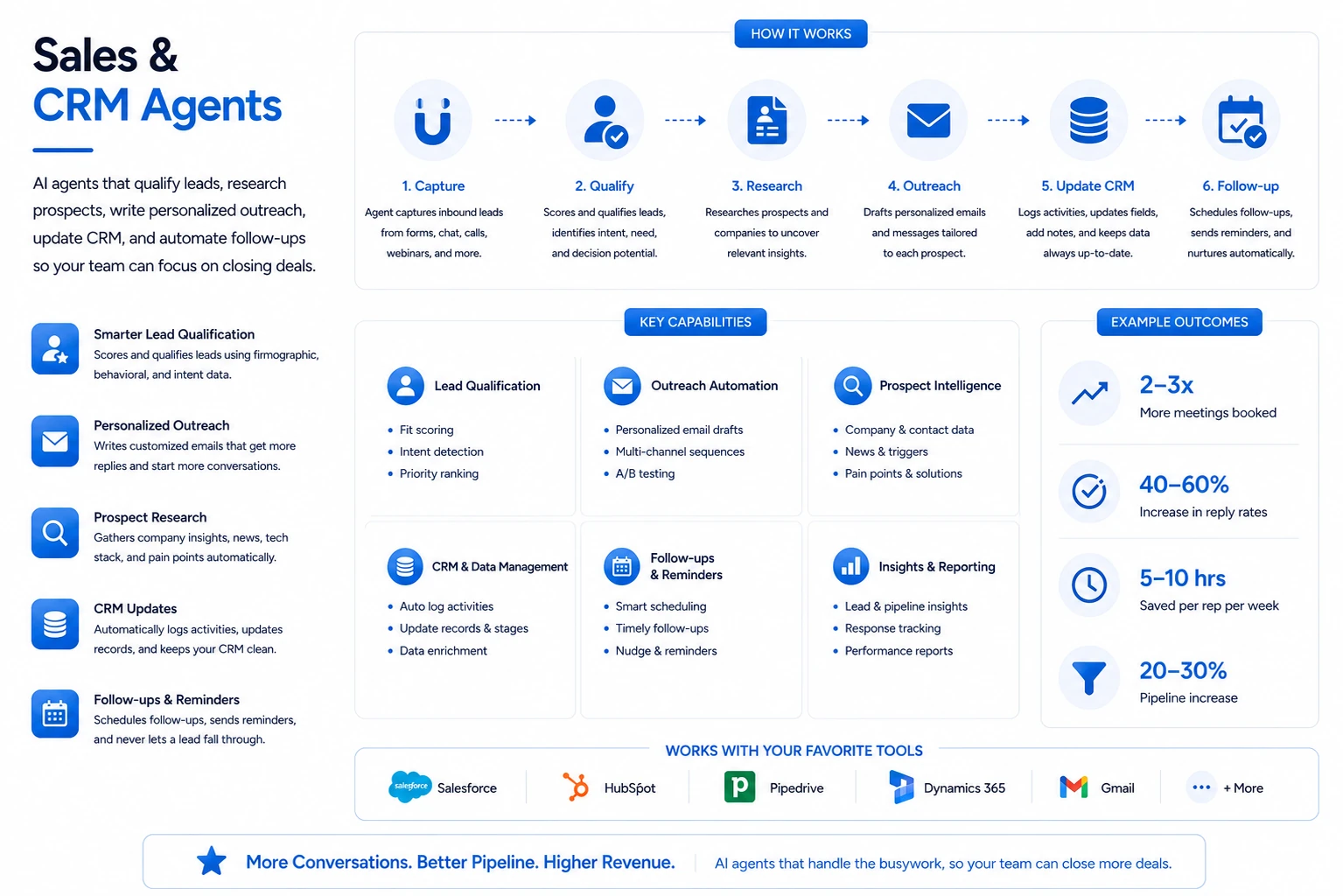
Sales & CRM Agents
Qualify leads, update records, prepare meeting notes and draft follow-ups in your CRM.
WITH AIDrafts go to the rep for approval before sending.
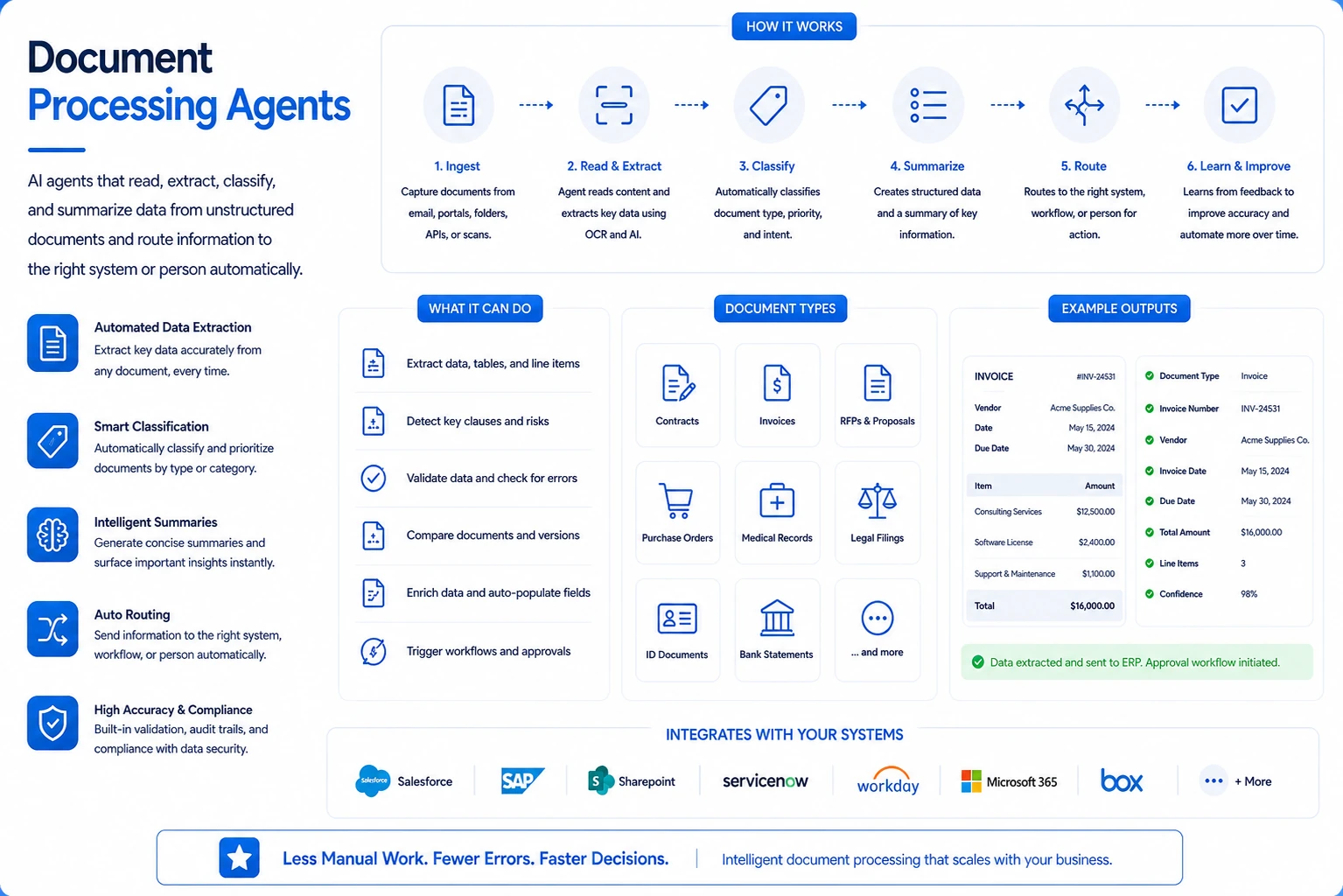
Document Processing Agents
Read, check and route contracts, invoices and applications, flagging what needs a person.
WITH AIConfidence thresholds send doubtful items to a reviewer.
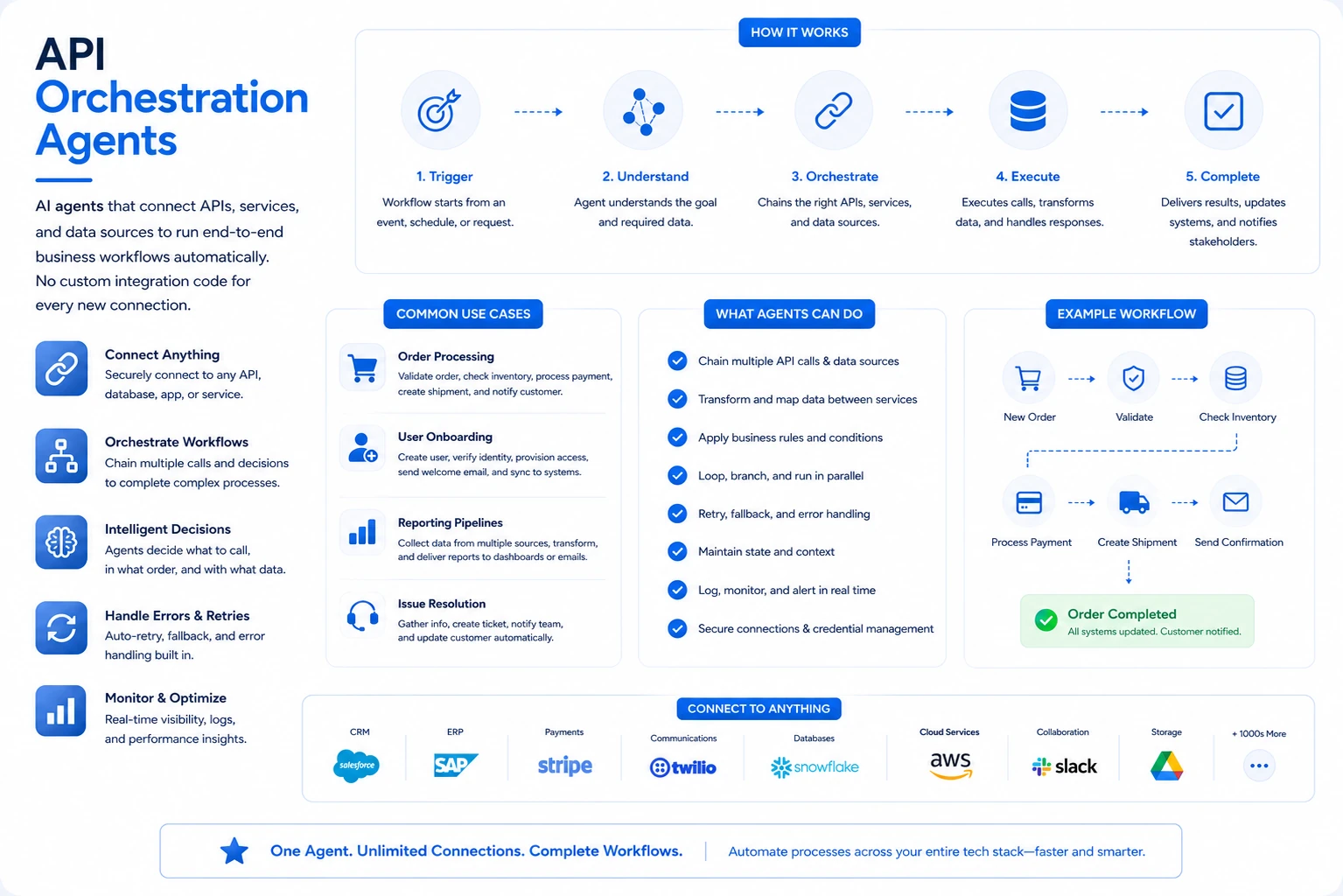
API Orchestration Agents
Coordinate calls across several systems to complete a task, handling errors and retries.
WITH AIEvery action is permission-limited and logged.
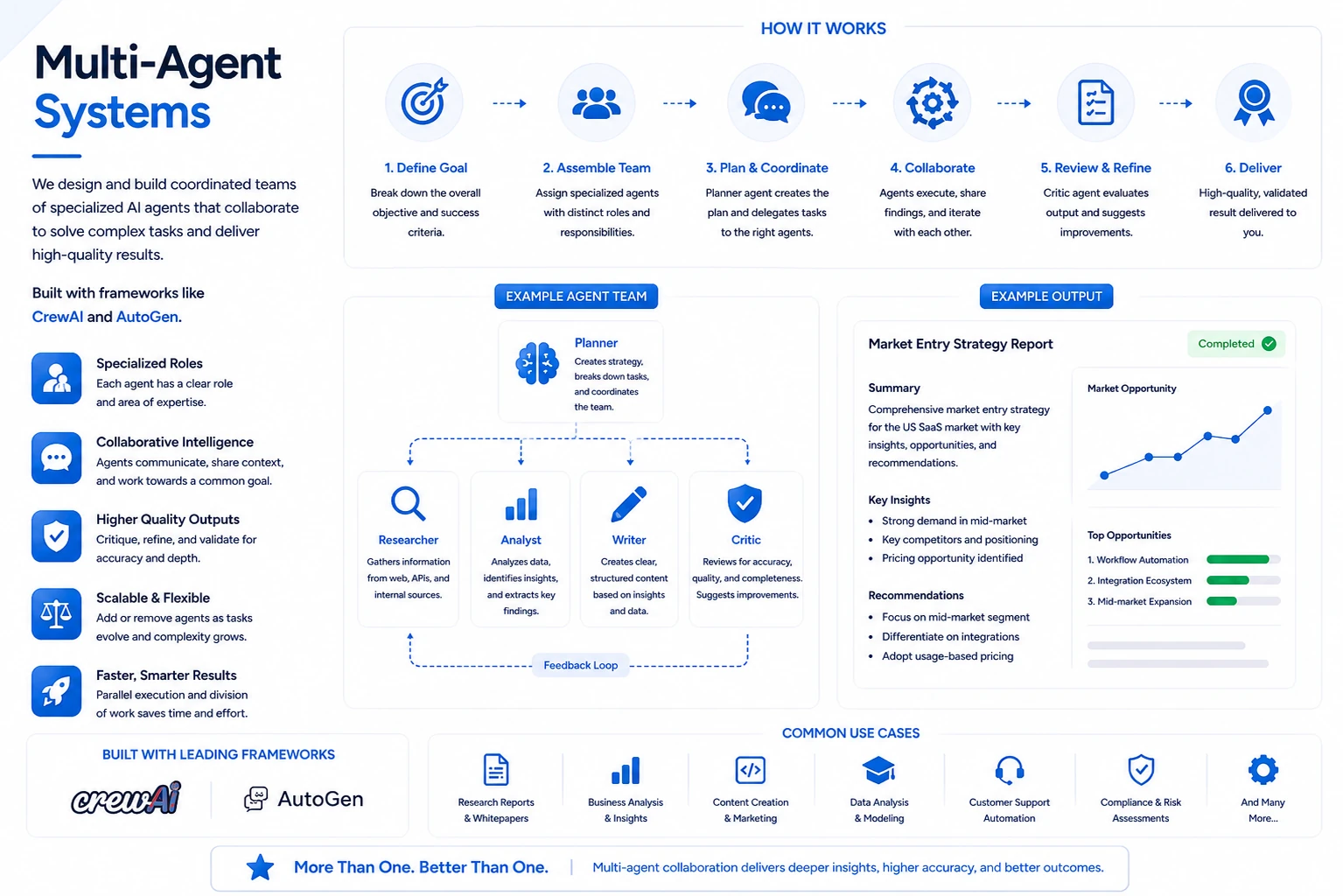
Multi-Agent Systems
Teams of specialised agents with a supervisor, for work too broad for a single agent.
WITH AIClear roles, shared memory and human checkpoints.
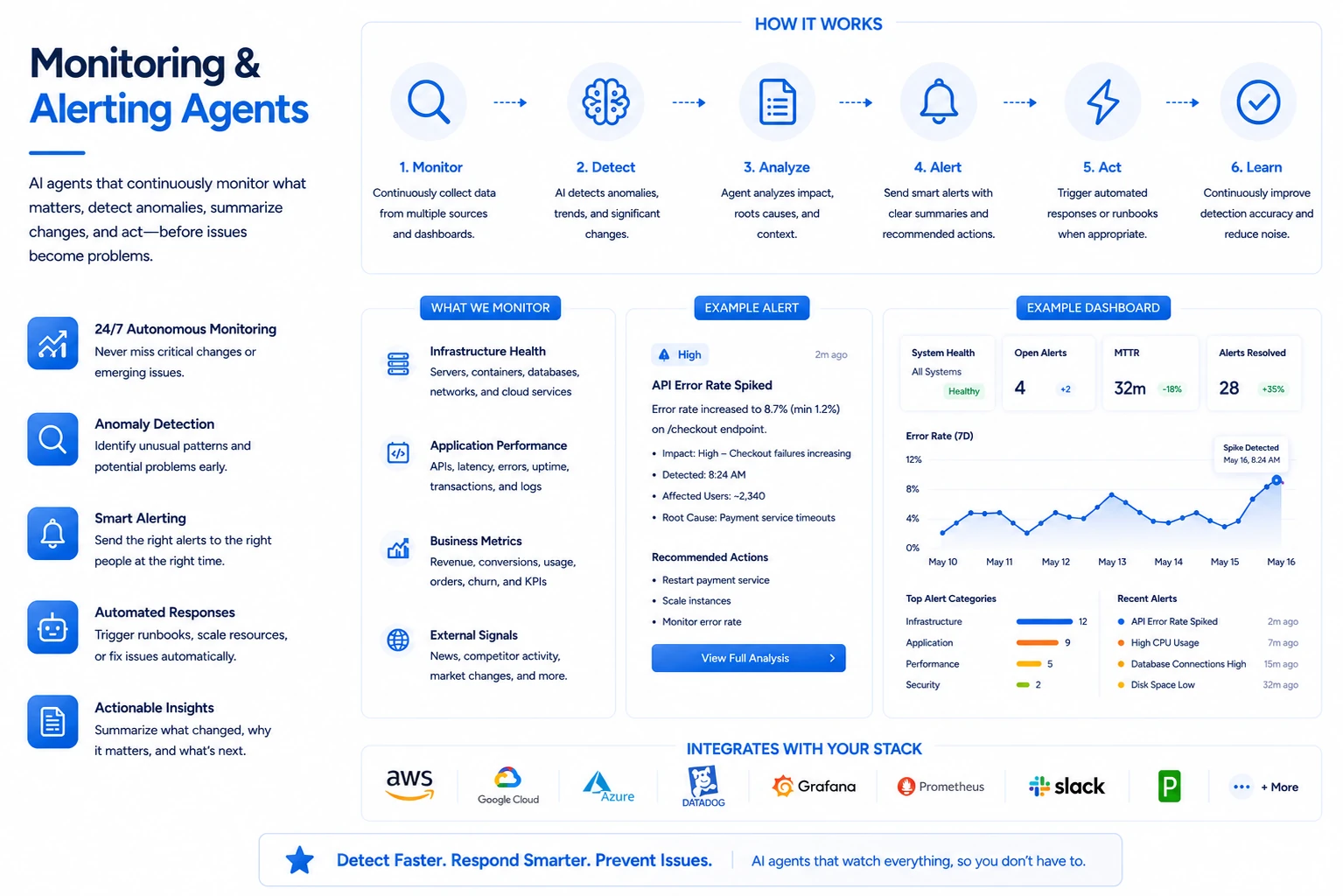
Monitoring & Alerting Agents
Watch data, systems or news around the clock, explain what changed and notify the right person.
WITH AIAlerts explain the cause and a suggested next step.
Inside an agent
What makes an agent trustworthy
Anyone can wire a model to a tool. The difference lies in what surrounds it: limits, memory, logging and oversight.
These six parts are in every agent we deliver.

Goal & plan
The agent turns a request into steps and checks progress against the goal.
Tools
It can search, read files, call APIs and update records, but only the ones you allow.
Memory
It keeps the context it needs, with limits on what it may store.

Guardrails
Permissions, spending limits and approval points stop it going beyond its brief.

Observability
Every step is logged, so you can see what it did and why.

Human oversight
People approve high-impact actions and can take over at any time.
How we work
From first task to supervised autonomy
Five steps that earn trust gradually.
Choose a task with edges
Start with a task that has a clear goal, limited tools and an easy way to check the result.
ScopeDefine tools and limits
List exactly what the agent may read, write and spend, and which actions need approval.
PermissionsBuild and test in a sandbox
Run the agent against realistic cases, including bad inputs and attempts to push it off task.
TestingPilot with supervision
Release to a small group with every action visible and easy to reverse.
PilotWiden autonomy gradually
Remove approvals only where the results justify it, and keep monitoring.
Scale
Safety you can check
Controls in every agent
What we verify before an agent touches real systems.
- Least privilegeThe agent has only the access its task needs, nothing more.
- Approval for risky actionsPayments, deletions and external messages need a person.
- Spending and rate limitsHard caps on cost, calls and time per task.
- Prompt-injection testsWe test whether hostile text in documents or web pages can hijack the agent.
- Full audit trailPrompts, tool calls and results are recorded for review.
- Kill switchA single control that stops the agent and rolls back where possible.
Does the agent need to answer from your documents?
RAG gives agents grounded knowledge, with sources and access control.
FAQs
AI agent questions, answered
An AI agent is software that uses a language model to plan steps, use tools such as search, databases and APIs, and complete a multi-step task toward a goal. Unlike a simple chatbot, it takes actions, so it needs limits and oversight.
A chatbot mainly answers questions. An agent can also act: look up a record, update a system, send a draft or trigger a workflow. That makes agents more powerful and means they need permissions, logging and approval steps.
They can be, if designed carefully. We use least-privilege access, approval for risky actions, spending limits, audit logs and tests for prompt injection. We start with narrow tasks and widen autonomy only when results justify it.
Tasks with a clear goal, defined tools and a checkable result, such as research briefs, lead qualification, document checking, ticket triage and monitoring. Open-ended or high-stakes decisions should stay with people.
A multi-agent system uses several specialised agents, for example a researcher, a writer and a checker, coordinated by a supervisor. It suits broad tasks but adds complexity, so we use it only when a single agent is not enough.
Yes. We connect agents to your CRM, ERP, ticketing, email, databases and internal APIs, with each connection restricted to the actions it needs.
Prompt injection is hostile text, hidden in a web page, email or document, that tries to make an agent ignore its instructions. We limit tools and permissions, treat outside content as untrusted, require approval for sensitive actions and test for these attacks.
We define success per task, such as correct outcome, time taken and cost, test on a set of realistic cases and track the same measures in production, including how often a person has to step in.
A focused task agent often takes four to eight weeks from scoping to a supervised pilot. Multi-agent systems and many integrations take longer.
Running cost depends on the model, number of steps and volume. We estimate cost per task early, and use caching, smaller models for simple steps and hard limits to keep it predictable.
Ready to put an agent to work?
Describe a multi-step task your team repeats. We will tell you whether an agent suits it, what limits it needs and how to pilot it safely.