API & Backend Development
 White-Label & Dedicated Teams - Offshore developers, maintenance and agency support
Headless CMS - Sanity, Payload, Storyblok, Prismic, Contentful, Strapi and Next.js
AI Solutions - AI agents, chatbots, automation and machine learning
WordPress & WooCommerce - Custom themes, plugins and online stores
Shopify & eCommerce - Shopify, BigCommerce, PrestaShop and Webflow builds
HubSpot CMS - Custom themes, modules and integrations
Custom Web Development - PHP, Laravel, CodeIgniter, CakePHP, MERN and MEAN
Mobile App Development - iOS, Android, Flutter and React Native
Business Software - CRM, ERP, SaaS and enterprise applications
UI/UX & Frontend - Figma, design systems and pixel-accurate Figma-to-HTML
Connections other teams can trust
API & Backend Development
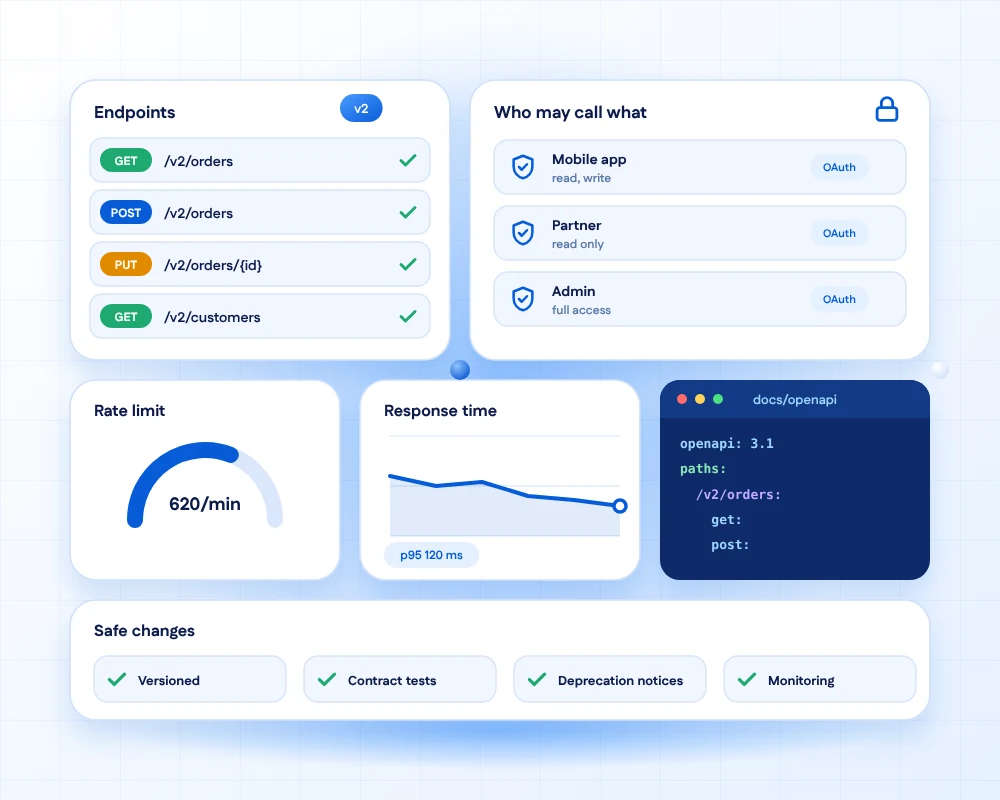
Every modern product is a conversation between systems: your app, your website, your partners, your payment provider. When the API behind it is slow, undocumented or changes without warning, everyone feels it.
We design APIs around a written contract, secure them properly, protect them with limits and watch them in production, so apps and partners can build on them with confidence.
We can build a new back end, tidy an existing one or connect the tools you already use.
- 11+Years of building business software
- 50+Global long-term clients
- 2,000+Projects delivered
- 24 hrsResponse time on queries
What a good API needs
Six parts of a dependable API
Missing any one of them shows up later as support work.

Design the contract
Resources, errors and versions agreed in an OpenAPI description before code is written.
Contract
Secure access
OAuth 2.0, API keys and scopes, so each caller sees only what it should.
Access
Protect the service
Rate limits, quotas and caching keep one noisy client from hurting the rest.
Limits
Document everything
Interactive docs, examples and a changelog that developers actually use.
Docs
Watch it run
Logs, metrics and alerts per endpoint and per client.
Monitor
Change safely
Versioning, deprecation notices and contract tests so updates do not break callers.
Evolve
Services
Our API & Backend Services
From a first endpoint to a platform of services.
REST and GraphQL APIs
Well-structured APIs for your web app, mobile app and partners.

Backend for web and mobile
One reliable service layer behind every screen, with authentication and roles.

Third-party integrations
Payments, shipping, CRM, ERP and messaging tools connected cleanly, with retries and logging.

Microservices and modular back ends
Split a growing system into parts that can change and scale on their own, only where it pays off.

Webhooks and event streams
Tell other systems the moment something happens, reliably and in order.

AI-ready APIs
Expose models and search to your products with limits, caching and cost tracking.
What we measure
An API is judged by its callers
We track these from launch day.
How we work
From callers to a living API
Five steps that keep integrations calm.
List the callers
Find who will call the API, what they need and what must never be exposed.
DiscoveryWrite the contract
Describe endpoints, data and errors in OpenAPI and review it with the callers.
DesignBuild and test
Implement against the contract with automated tests for success, failure and abuse.
BuildPublish and onboard
Release docs, a sandbox and sample code, and help the first callers connect.
LaunchRun and evolve
Monitor use, version changes and retire old versions with notice.
Operate
Built to be trusted
What we verify before release
The details that decide whether partners stay.
- Authentication and scopesEvery endpoint is protected, and permissions are tested.
- Input validationBad or oversized requests are rejected cleanly with helpful errors.
- Idempotent writesRetrying a payment or order request never creates a duplicate.
- Consistent errorsPredictable status codes and messages across the whole API.
- Contract testsChanges are checked against the published contract before release.
- Audit logsYou can see who called what and when.
Related services
Go further with these
APIs often sit at the centre of bigger projects.

FAQs
API and backend questions, answered
An API is how one piece of software talks to another. API development means designing, building, securing and documenting those connections so web apps, mobile apps and partners can use your data and services reliably.
REST is simple, widely understood and works well for most cases. GraphQL helps when many different screens need different slices of the same data. We recommend based on your clients and team.
We use proven authentication such as OAuth 2.0, scoped permissions, input validation, rate limits and encrypted traffic, and we test for the common risks listed in the OWASP API Security guidance.
Yes. We can describe an existing API in OpenAPI, publish interactive documentation and add examples, which often cuts support questions from partners.
We version the API, write contract tests, announce deprecations early and keep old versions running for an agreed period.
Yes. We integrate payments, shipping, CRM, ERP, marketing and messaging tools, with retries, queues and logging so a failure in one place does not stop the rest.
Not always. A well-organised single service is simpler and cheaper for many products. We recommend splitting only when teams, scale or release speed clearly need it.
Yes. We expose search, summaries or predictions through an API with caching, usage limits and cost tracking, so teams can build on them safely.
A focused API often takes four to eight weeks for a first release. Larger platforms with many integrations are delivered in phases.
Yes. We monitor traffic and errors, handle security updates, support partners and plan new versions under a support plan.
Ready for an API people can build on?
Tell us who will call it and what they need. We will propose a contract, a security approach and a plan, with an honest estimate.