AI-Powered Flutter App Development
 White-Label & Dedicated Teams - Offshore developers, maintenance and agency support
Headless CMS - Sanity, Payload, Storyblok, Prismic, Contentful, Strapi and Next.js
AI Solutions - AI agents, chatbots, automation and machine learning
WordPress & WooCommerce - Custom themes, plugins and online stores
Shopify & eCommerce - Shopify, BigCommerce, PrestaShop and Webflow builds
HubSpot CMS - Custom themes, modules and integrations
Custom Web Development - PHP, Laravel, CodeIgniter, CakePHP, MERN and MEAN
Mobile App Development - iOS, Android, Flutter and React Native
Business Software - CRM, ERP, SaaS and enterprise applications
UI/UX & Frontend - Figma, design systems and pixel-accurate Figma-to-HTML
Beautiful apps, one codebase
Flutter App Development
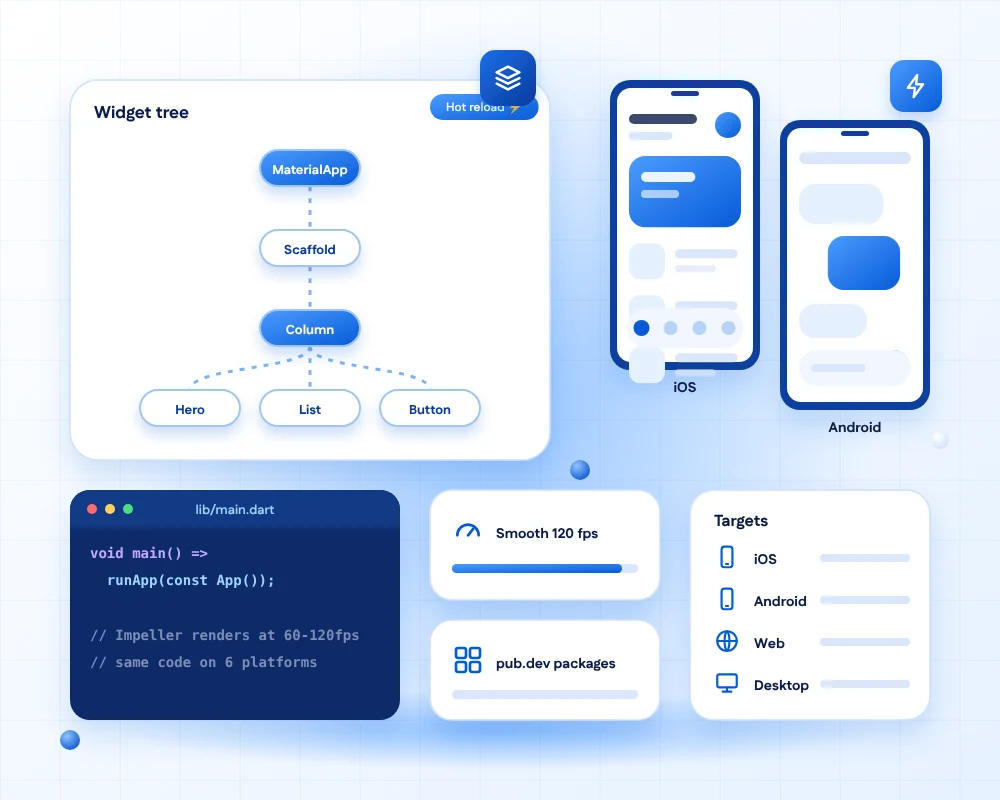
Flutter lets one team build one app that looks and feels the same on iPhone, Android, the web and the desktop. The design you approve is the design every user sees.
We build Flutter apps with clean architecture, a proper test suite and a delivery pipeline, so the first release is solid and the tenth is just as easy to ship.
AI speeds up testing and powers helpful features inside the app. Our engineers review everything that reaches your users.
- 11+Years of building business software
- 50+Global long-term clients
- 2,000+Projects delivered
- 24 hrsResponse time on queries
Why Flutter
Why choose Flutter?
Six reasons teams build their next app with it.

One Codebase
Write the app once in Dart and ship it to iOS and Android, with web and desktop available from the same project.

Expressive Interfaces
Flutter draws every pixel itself, so custom designs, branded motion and rich animation look the same on every device.

Fast Iteration
Hot reload shows changes in a running app within a moment, which shortens the loop between design and working screen.

Smooth Performance
Compiled to native code, Flutter apps can hold smooth frame rates on a wide range of phones.

Rich Widget Library
Material and Cupertino widgets are included, and a large package ecosystem covers common needs.

Lower Total Cost
One team and one test suite instead of two reduces build and maintenance cost.
Where it fits
Apps that suit Flutter well
Flutter is a strong choice when the interface matters and you want to reach both platforms with one team.
If your app depends heavily on very platform-specific features, we will tell you honestly and suggest native code for those parts, or a fully native approach.

Startups and MVPs
Get a polished product on both platforms with a small team, then grow from real feedback.
Brand-led consumer apps
When the design is distinctive and has to look identical on iPhone and Android.

Commerce and marketplaces
Catalogues, carts, payments and order tracking, with the same behaviour for every customer.

Dashboards and internal tools
Data-heavy screens, charts and forms for staff on phones, tablets and desktops.

Health, fitness and wellbeing
Tracking, reminders and wearables connections, with careful handling of personal data.
AI in Flutter development
Faster testing, smarter apps
AI covers the repetitive checks and powers useful features. People make the product decisions.

AI-generated widget tests
Widget, golden and integration tests are drafted from your screens, then reviewed by our engineers.

Golden-image checks
Screens are compared against approved images on many sizes, so unplanned visual changes are caught.

On-device and cloud AI
Assistants, smart search and camera features added through well-tested packages and native bridges.
Performance profiling
Jank and slow starts are found with profiling data, then fixed screen by screen.
Our Flutter toolbox
How we build it
Proven, well-supported tools that keep the codebase easy to change.
Flutter & Dart
Null-safe Dart and the stable Flutter channel, with a clear upgrade policy.

State management
Riverpod, Bloc or Provider, chosen to match your team and app size.

Local data
Drift, Isar or Hive for offline data, with secure storage for tokens.

Networking
Dio and generated API clients with typed models and retry rules.
Testing
Unit, widget, golden and integration tests running on every pull request.
Delivery
Fastlane and CI pipelines for TestFlight, Google Play and web releases.
Services
Our Flutter Services
From first sketch to long-term support.

Custom Flutter Apps
Apps built around your product, with clean architecture and a test suite you can trust.

Flutter UI/UX
Branded interfaces and motion built from your design system as reusable widgets.

Flutter Web & Desktop
Extend a mobile app to the browser and desktop, where it makes sense for your users.

Native to Flutter Migration
Move existing iOS and Android apps to one Flutter codebase, screen by screen, while you keep shipping.
Plugins & Native Modules
Custom platform code for Bluetooth, payments or hardware that off-the-shelf packages do not cover.

Maintenance & Upgrades
Flutter and Dart upgrades, store policy changes, dependency updates and crash fixes on a schedule.
How we work
A typical first-release timeline
An example plan. Your own timeline depends on scope.
- Weeks 1–2
Discover & design
Goals, users and a clickable prototype that is tested before any code is written.
- User flows
- Design system
- Prototype
- Weeks 3–8
Build in sprints
Two-week sprints, each ending with a build you can install on your own phone.
- Feature slices
- Backend & APIs
- Code review
- Weeks 9–10
Test & harden
Real-device testing, accessibility checks and performance tuning on mid-range phones.
- Device matrix
- Accessibility
- Profiling
- Week 11+
Launch & grow
Store listings, staged rollout, analytics and a roadmap based on how people use the app.
- App Store
- Google Play
- Analytics
Quality you can check
What we verify before every release
The details that decide whether users keep the app.
- Both platforms checkedEach feature is tested on iOS and Android, not assumed to match.
- Smooth on mid-range phonesWe profile on modest devices so scrolling and animation stay smooth for most users.
- AccessibilityScreen reader labels, text scaling and contrast are checked on every screen.
- Small app sizeUnused assets and packages are trimmed to keep downloads light.
- Dependency healthWe review packages for maintenance and licence before adding them.
- Secure by defaultSecure storage, certificate checks and safe handling of tokens and user data.
Not sure which framework is right?
Compare Flutter, React Native, hybrid and native options for your product.
FAQs
Flutter & AI questions, answered
Flutter is Google’s open-source toolkit for building apps for mobile, web and desktop from one codebase. Apps are written in the Dart language and Flutter draws its own interface, which gives designers precise control over how the app looks and moves.
Yes. Many consumer and business apps are built with Flutter. It works especially well for products with custom design, and it benefits from compiled native code and a mature package ecosystem.
Flutter suits teams who want identical, highly custom interfaces on every platform. React Native suits teams with strong JavaScript and React skills who want native components. We compare both against your team, design and features before recommending one.
Yes. Camera, GPS, biometrics, push notifications, Bluetooth and payments are available through packages or small native modules. For anything unusual, we write the platform code ourselves.
Yes, from the same project. We use web and desktop where they fit, for example admin dashboards. Public content sites are usually better built with web technology, and we advise honestly.
AI speeds up drafting widget and integration tests, comparing screenshots, profiling performance and building features such as assistants and smart search. Engineers review all of it before release.
It depends on features, integrations and design. A shared codebase usually costs less than two native apps. After discovery we agree a fixed price for a first release or a monthly team model.
A focused first release often takes two to four months. We ship working builds every two weeks, so you see progress and can change direction early.
Yes. Flutter can be added to an existing iOS or Android app screen by screen, so you do not need a risky full rewrite.
Yes. We provide Flutter upgrades, OS-compatibility work, crash monitoring and new features under a plan with agreed response times.
Ready to build your Flutter app?
Tell us about your idea or your existing app. We will propose a first release, the architecture and where AI will genuinely help.