Node.js Development
 White-Label & Dedicated Teams - Offshore developers, maintenance and agency support
Headless CMS - Sanity, Payload, Storyblok, Prismic, Contentful, Strapi and Next.js
AI Solutions - AI agents, chatbots, automation and machine learning
WordPress & WooCommerce - Custom themes, plugins and online stores
Shopify & eCommerce - Shopify, BigCommerce, PrestaShop and Webflow builds
HubSpot CMS - Custom themes, modules and integrations
Custom Web Development - PHP, Laravel, CodeIgniter, CakePHP, MERN and MEAN
Mobile App Development - iOS, Android, Flutter and React Native
Business Software - CRM, ERP, SaaS and enterprise applications
UI/UX & Frontend - Figma, design systems and pixel-accurate Figma-to-HTML
Fast back ends, built to last
Node.js Development for Real-Time Products
Some features need an answer in milliseconds: a chat message, a live order status, an AI reply streaming onto the screen. A slow or fragile back end shows up as unhappy users.
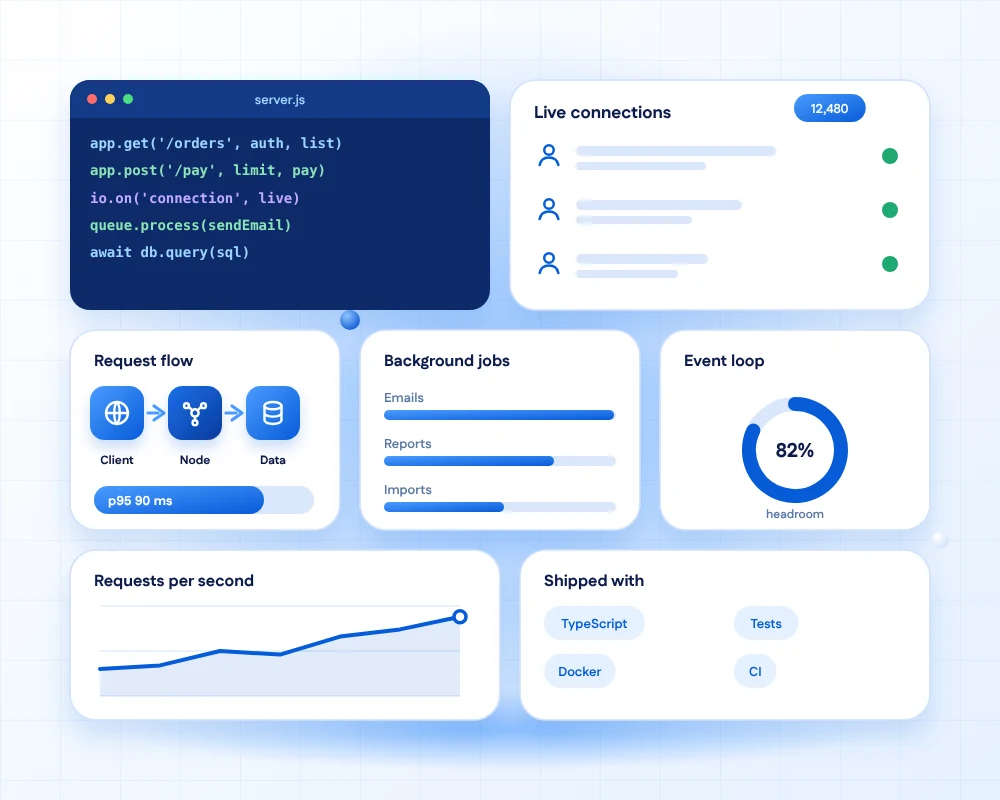
We build Node.js services in TypeScript that stay fast under load, with queues for slow work, tests for every change and monitoring that tells you what is happening.
The same team can add AI features, connect your other systems and keep it all running after launch.
- 11+Years of building business software
- 50+Global long-term clients
- 2,000+Projects delivered
- 24 hrsResponse time on queries
Where Node.js fits
Six jobs Node.js does well
Pick it when speed, real-time and a shared language matter.

Real-time features
Live chat, notifications, dashboards, collaboration and tracking, pushed to users as things happen.
Realtime
APIs and integrations
REST and GraphQL APIs that connect your apps, partners and third-party tools.
APIs
Back ends for web and mobile
One service layer for your website, your apps and your admin tools.
Back end
Background jobs and queues
Emails, reports, imports and clean-ups that run behind the scenes without slowing users down.
Jobs
AI-powered back ends
Streaming answers from language models, document search and automation steps, wired into your product.
AI
Serverless and microservices
Small, focused services that scale on their own and cost little when quiet.
Cloud
How we build
Lean, typed and observable
We choose boring, proven tools and keep services small enough to understand.
Every service ships with tests, logs and alerts, so it can be run by your team, not only by ours.

TypeScript first
Typed code catches mistakes early and makes a large codebase easier to change.

Right framework for the job
Express or Fastify for lean services, NestJS for larger structured systems.

Your choice of database
PostgreSQL, MySQL, MongoDB and Redis, with migrations and clear data models.

Secure by default
Input validation, safe authentication, secrets management and dependency scanning.

Tuned for load
Caching, connection pooling and queue workers keep response times steady.

Observable
Structured logs, metrics and alerts so problems show up before customers notice.
What we measure
A back end is judged by what users feel
We set these targets early and report on them after launch.
How we work
From workload to monitored service
Five steps that avoid surprises in production.
Map the workload
Understand who calls the service, how often and what must happen in real time and what can wait.
DiscoveryDesign the contract
Agree the API shape, data model and error handling before writing code.
DesignBuild in small slices
Ship working endpoints early, each with tests and documentation.
BuildTest under load
Load and failure tests show where the service bends before real users find out.
ProveLaunch and watch
Deploy with monitoring, alerts and a rollback plan, then tune from real traffic.
Operate
Built to be trusted
What we verify before every release
The details that decide whether a service stays up.
- Typed and testedTypeScript, unit and integration tests run on every change.
- Safe error handlingFailures are caught, logged and retried where it makes sense, never swallowed.
- Graceful shutdownDeployments finish in-flight requests, so users never see a dropped connection.
- Rate limits and validationEvery input is checked and abuse is throttled.
- Dependency hygienePackages are pinned, scanned and updated on a schedule.
- DocumentedClear API docs, a README and run books for your team.
Related services
Build the whole product around it
A fast back end pairs well with these.
FAQs
Node.js questions, answered
Node.js runs JavaScript on the server. It suits APIs, real-time features, streaming and services that spend most of their time waiting on databases or other services. For heavy number crunching we may pair it with another language.
There is no single winner. Node.js shines for real-time features and for teams that want one language across front end and back end. PHP and Python are excellent for other cases. We recommend based on your team, workload and existing systems.
Yes, by default. Types catch many bugs before release and make the code easier for new developers to understand. We can work in plain JavaScript if your codebase already uses it.
Express and Fastify for lean services, NestJS for larger structured applications, plus tools such as Prisma, TypeORM and Socket.IO. We pick the lightest option that fits.
Yes, when it is built well. We use caching, queues and horizontal scaling, and we load test before launch so the limits are known rather than guessed.
Yes. We connect language models, stream their answers to the browser, add document search and build approval steps for actions, with cost limits and logging.
We validate input, manage secrets safely, use proven authentication libraries, scan dependencies and follow the OWASP guidance. Security checks are part of the build pipeline.
Yes. We start with an audit of dependencies, tests, security and performance, then fix the highest-risk areas first while the service keeps running.
A focused API or service often takes four to eight weeks for a first release. Larger platforms are delivered in phases over several months.
Yes. We monitor the service, apply security updates and tune performance under a support plan with agreed response times.
Ready for a back end that keeps up?
Tell us what the service must do and how many people will use it. We will suggest an architecture, a plan and an honest estimate.