AI-Assisted Integration & API Development
 White-Label & Dedicated Teams - Offshore developers, maintenance and agency support
Headless CMS - Sanity, Payload, Storyblok, Prismic, Contentful, Strapi and Next.js
AI Solutions - AI agents, chatbots, automation and machine learning
WordPress & WooCommerce - Custom themes, plugins and online stores
Shopify & eCommerce - Shopify, BigCommerce, PrestaShop and Webflow builds
HubSpot CMS - Custom themes, modules and integrations
Custom Web Development - PHP, Laravel, CodeIgniter, CakePHP, MERN and MEAN
Mobile App Development - iOS, Android, Flutter and React Native
Business Software - CRM, ERP, SaaS and enterprise applications
UI/UX & Frontend - Figma, design systems and pixel-accurate Figma-to-HTML
Systems that talk
Enterprise Integration & API Development
Most businesses run on a dozen tools that were never designed to work together. People bridge the gaps by copying data between screens, and every new tool adds another gap.
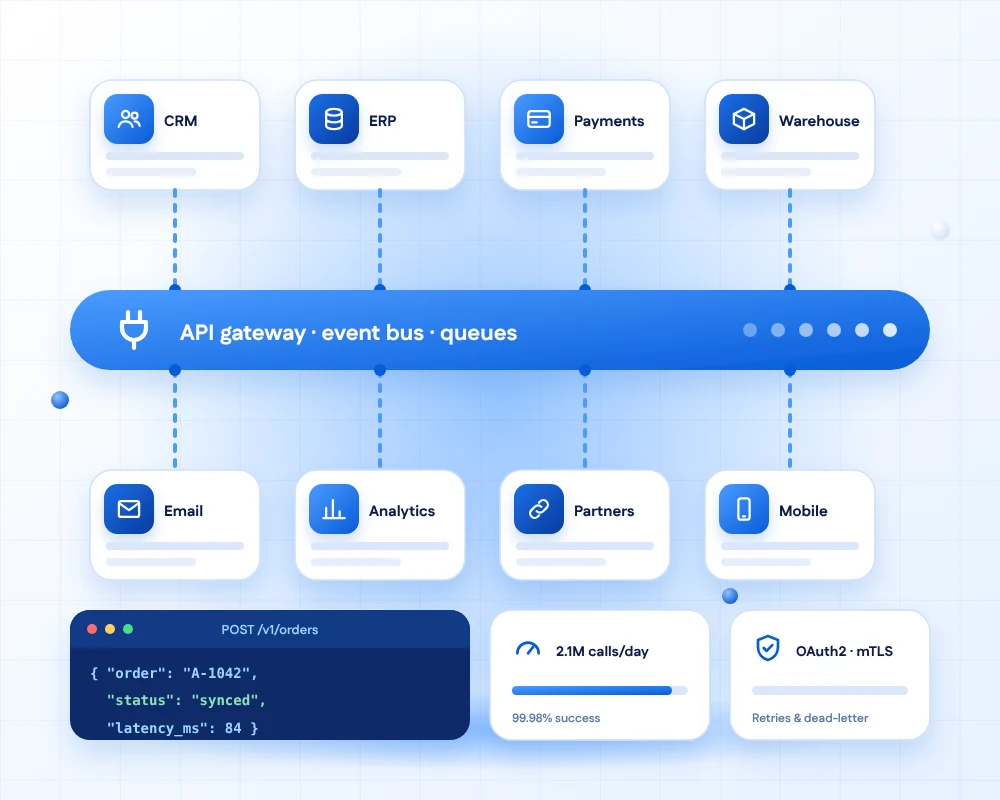
We connect your CRM, ERP, payment, logistics, cloud and partner systems with reliable APIs, event flows and monitoring, so data moves once, correctly, and you can see when it does not.
AI accelerates the slow parts: mapping fields, drafting documentation and generating tests. Our engineers design the contracts and approve every mapping.
- 11+Years of building business software
- 50+Global long-term clients
- 2,000+Projects delivered
- 24 hrsResponse time on queries
Why an integration layer
From tangled scripts to one clear layer
The difference between connecting everything to everything, and connecting once.
Point-to-point
Fast to start, painful to maintain- Data retyped between systems, with errors and delays
- Point-to-point scripts that nobody dares to touch
- No visibility when a sync fails until a customer complains
- Every new system multiplies the number of connections to maintain
Integration layer
A little more design, far less pain- One integration layer with clear contracts and versioning
- Retries, queues and dead-letter handling built in
- Monitoring and alerts that show what failed and why
- New systems plug in once instead of connecting to everything
What we build
Six ways to connect systems
The right pattern depends on speed, volume and how the other system behaves.

REST & GraphQL APIs
Well-designed, documented APIs that expose your data and workflows to apps, partners and AI tools.
Real-time
Events & webhooks
Systems react to things as they happen, such as a new order or a payment, instead of polling.
Event-driven
EDI & file exchange
Reliable handling of CSV, XML and EDI documents with trading partners and legacy systems.
Batch
Data synchronisation
Two-way sync between systems with conflict rules, so records match everywhere.
Two-way
ETL & data pipelines
Move and shape data into warehouses and reports on a schedule you control.
Analytics
Legacy adapters
APIs wrapped around systems that never had one, so they can join the modern stack.
Bridge
AI in integration
Faster mapping, fewer surprises
AI shortens the repetitive work. Engineers own data accuracy and reliability.
Smart field mapping
AI suggests how fields in one system map to another and flags mismatches, for an engineer to confirm.
API documentation
Docs, examples and client libraries are drafted from the API definition and then checked by engineers.

Contract and load tests
Test cases are generated from API specs to catch breaking changes before they ship.

Failure triage
Errors are grouped by root cause, so teams fix one problem instead of a thousand alerts.
Built to be reliable
Reliability is not optional
Data connections fail in the real world, and these habits keep failures small and visible.
- Idempotent operationsRetried requests never create duplicate orders or payments.
- Retries and back-offTemporary failures recover automatically without flooding the other system.
- Dead-letter queuesMessages that cannot be processed are parked, visible and replayable.
- Versioned contractsChanges do not break consumers, because old versions keep working until they migrate.
- Security by defaultOAuth 2.0, API keys, signed webhooks, encryption and rate limiting.
- ObservabilityLogs, metrics and traces with dashboards for every integration.
How we work
From system map to monitored launch
Five steps that avoid surprises on go-live day.
Map systems and data
List the systems, owners, data flows and today’s pain, and agree what must happen in real time.
DiscoveryDesign the contracts
Define APIs, events and data models, with versioning and error rules agreed up front.
API-firstBuild and mock
Build integrations against mocks, so work does not wait for every system to be ready.
Parallel workTest end to end
Contract, load and failure tests, including what happens when a partner system is down.
AI-assistedLaunch with monitoring
Go live with dashboards and alerts, and runbooks for your support team.
Observable
Automating the work that sits between your systems?
Workflow automation uses these integrations to remove manual steps, approvals and re-keying.
FAQs
Integration & AI questions, answered
It is connecting the systems a business relies on, such as CRM, ERP, accounting, eCommerce, logistics and partner platforms, so data flows between them automatically and consistently instead of being retyped.
An API is an interface that lets one system request data or actions from another. An integration is the working connection built using such interfaces, including mapping, error handling, security and monitoring.
Yes. We connect CRMs such as HubSpot or Salesforce with ERPs and accounting tools, so quotes, orders, invoices and customer records stay consistent in both places.
Yes. We design secure REST and GraphQL APIs, with documentation, authentication, rate limiting and versioning, so your partners and apps can rely on them.
AI speeds up mapping fields between systems, drafting documentation, generating tests and grouping errors by cause. Engineers still design the contracts and approve every mapping, because data accuracy is critical.
We design for it. Messages are queued, retried with back-off, and parked in dead-letter queues if they still fail, so nothing is lost and your team can replay them once the system recovers.
Usually yes. We build adapters that read from databases, files or screens and expose a clean API. That lets old systems join the rest of the stack while you plan any modernization.
We use OAuth 2.0 or API keys, signed webhooks, TLS encryption, least-privilege access, secret management and rate limiting. Sensitive data is minimised and logged access is auditable.
Low-code iPaaS tools suit simple, standard connections. Custom integration is better for complex logic, high volume, unusual systems or when you want full control. We recommend the lighter option where it fits.
Yes. We set up dashboards and alerts, and offer support plans so failed syncs are noticed and fixed quickly.
Ready to connect your systems?
List the tools you use and where data gets stuck. We will propose an integration design, the order to build in and how we will monitor it.