AI Automation Services
 White-Label & Dedicated Teams - Offshore developers, maintenance and agency support
Headless CMS - Sanity, Payload, Storyblok, Prismic, Contentful, Strapi and Next.js
AI Solutions - AI agents, chatbots, automation and machine learning
WordPress & WooCommerce - Custom themes, plugins and online stores
Shopify & eCommerce - Shopify, BigCommerce, PrestaShop and Webflow builds
HubSpot CMS - Custom themes, modules and integrations
Custom Web Development - PHP, Laravel, CodeIgniter, CakePHP, MERN and MEAN
Mobile App Development - iOS, Android, Flutter and React Native
Business Software - CRM, ERP, SaaS and enterprise applications
UI/UX & Frontend - Figma, design systems and pixel-accurate Figma-to-HTML
Work that moves by itself
AI Automation With People in Charge
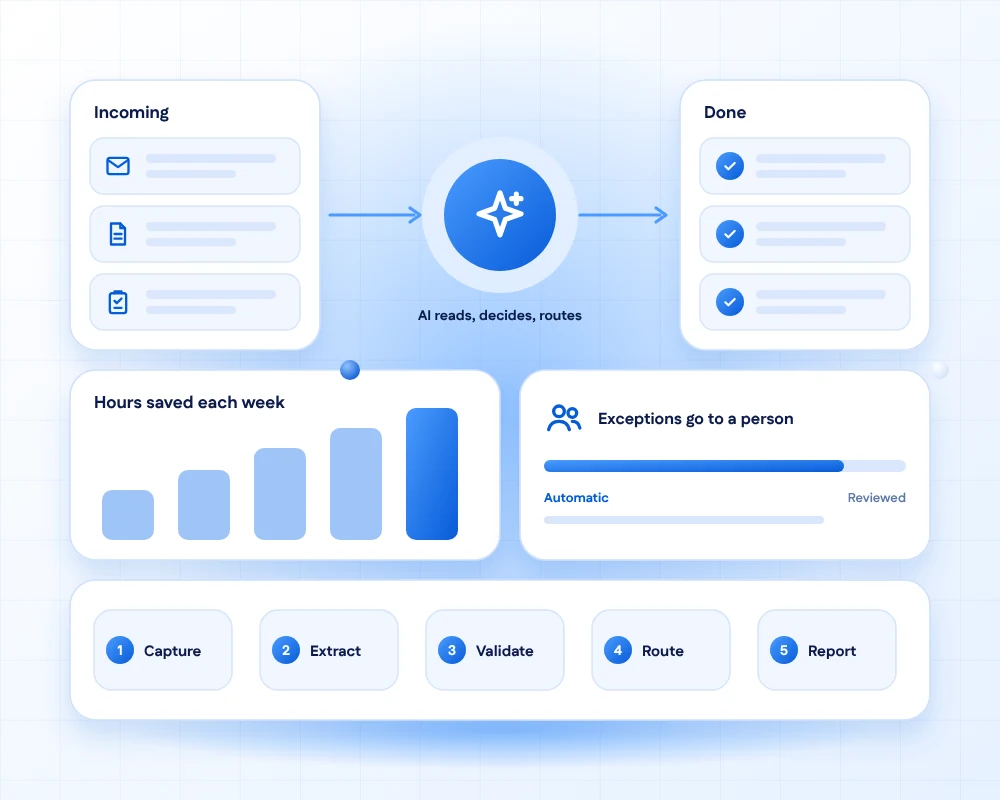
Every business has work that sits in inboxes and spreadsheets: documents to read, requests to route, reports to assemble. Rule-based automation cannot handle it because the inputs are never quite the same.
We build AI automation that reads documents and messages, decides where each case goes and triggers the next step, while people review whatever the system is unsure about.
Everything is measured against how the work is done today, so you can see the hours saved and the errors avoided.
- 11+Years of building business software
- 50+Global long-term clients
- 2,000+Projects delivered
- 24 hrsResponse time on queries
Choosing a method
Rules, RPA, AI or people?
Each has a place. Strong automations combine them.
| Method | How it works | A good fit for | Trade-off |
|---|---|---|---|
| Scripts and rules | Fixed steps for fixed inputs | Stable, structured tasks | Breaks when inputs change |
| Traditional RPA | Software robots repeating screen actions | Legacy systems with no API | Fragile on layout changes, cannot read free text |
| AI automation | Models read, classify and decide, then trigger actions | Documents, email, free text and varied cases | Needs testing and a review step for unusual cases |
| Human in the loop | People confirm what the AI is unsure about | Anything with money, legal or customer impact | Slower than full automation, safer for risky steps |
We recommend the simplest method that does the job reliably.
Services
Our AI Automation Services
Six areas where automation removes the most manual effort.
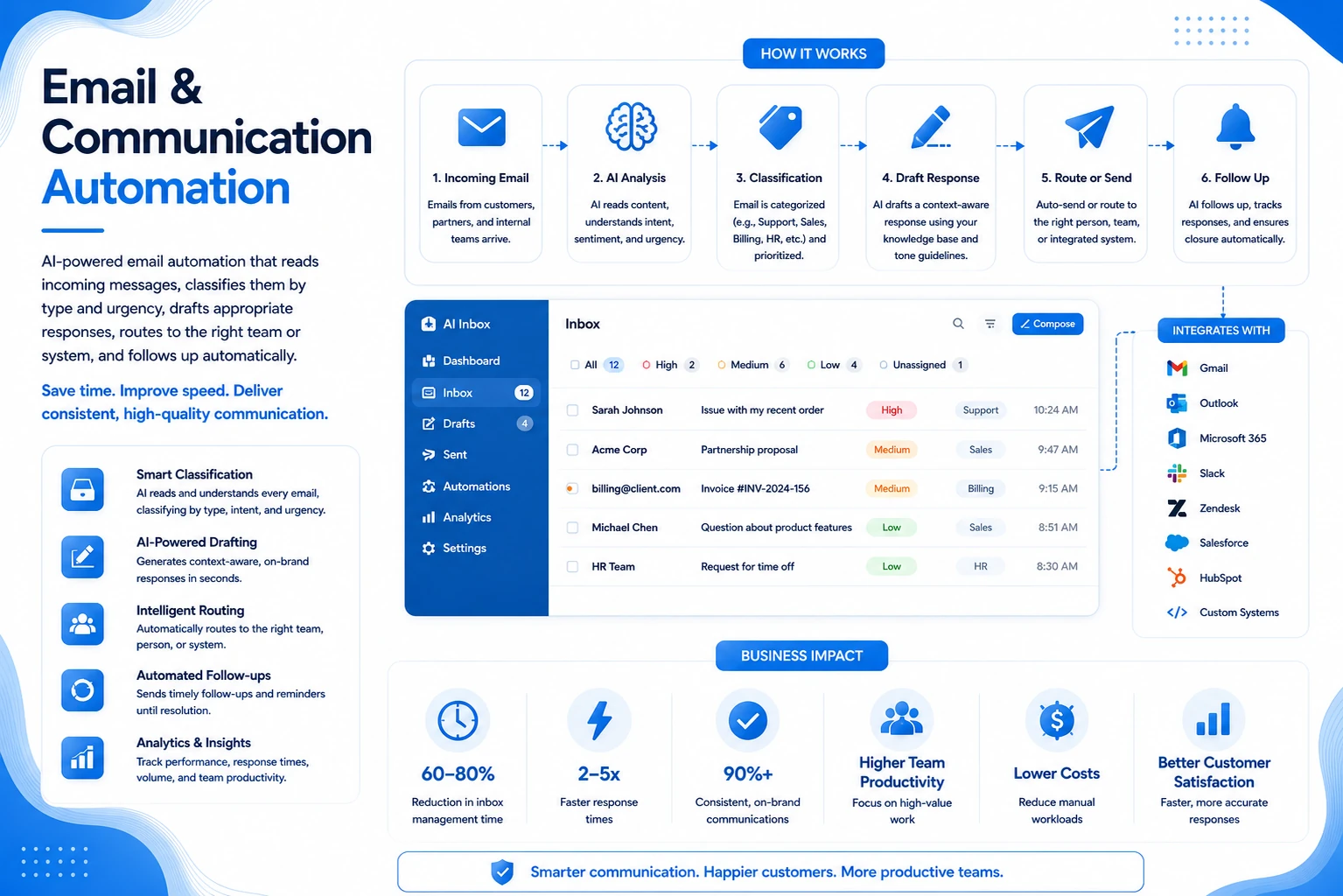
Email & Communication Automation
Triage, classify, answer and route inbound messages, with drafts a person can approve.
WITH AIIntent and urgency detected on every message.
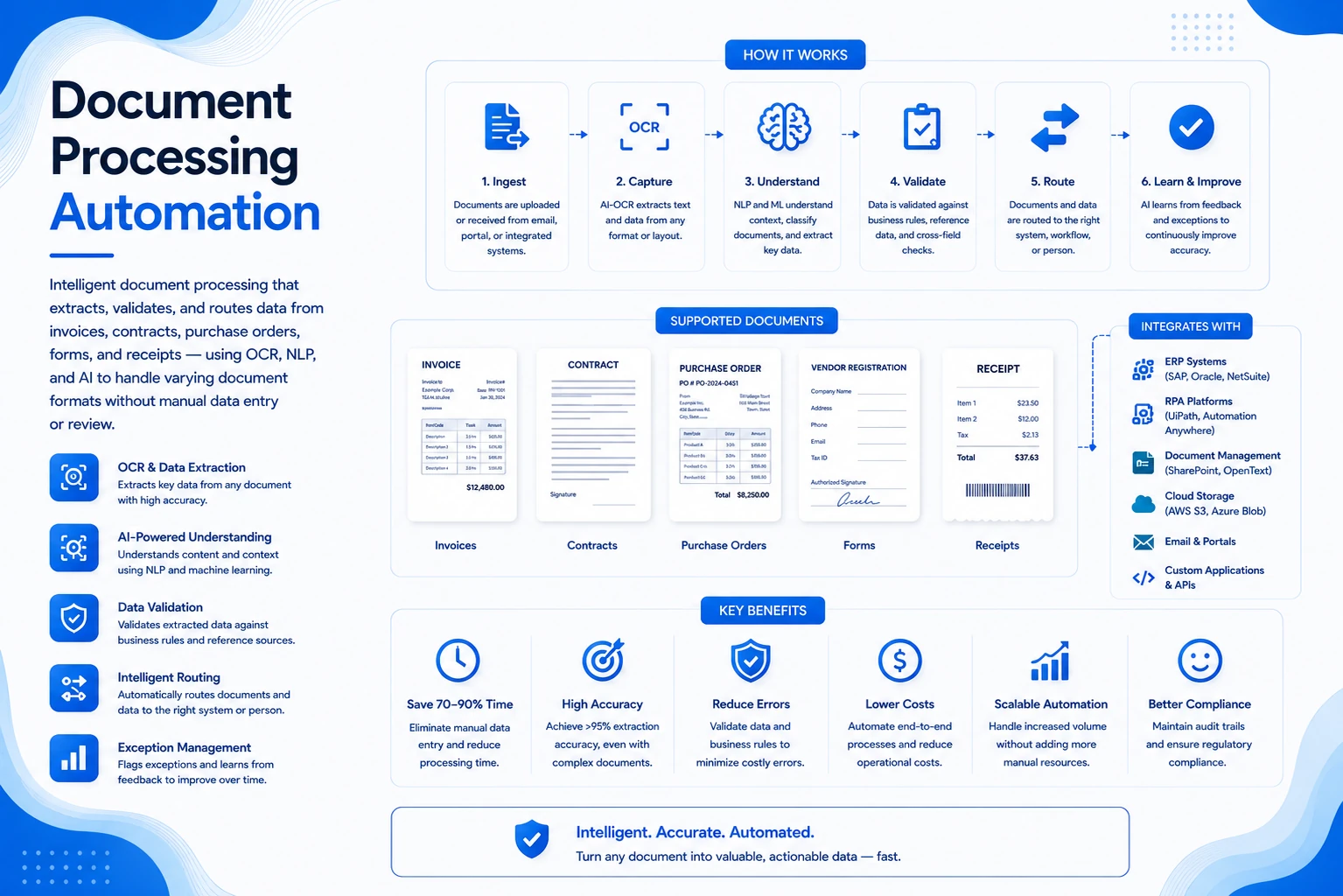
Document Processing Automation
Read invoices, forms, contracts and IDs, extract the fields and push them into your systems.
WITH AIConfidence scores send doubtful items to a reviewer.
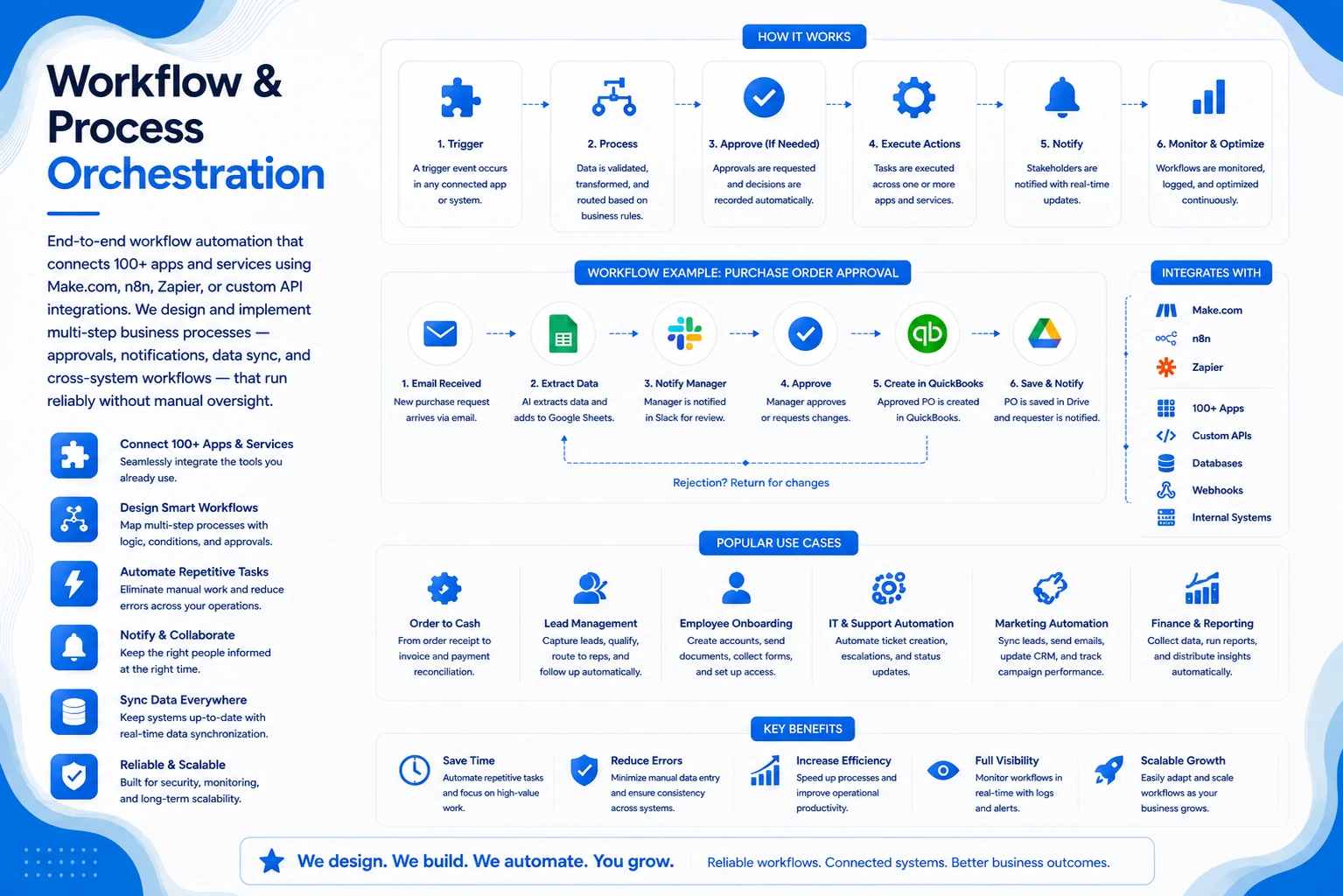
Workflow & Process Orchestration
Connect steps, approvals and systems into one flow, with AI deciding where each case goes.
WITH AIRouting learned from how your team handles cases today.
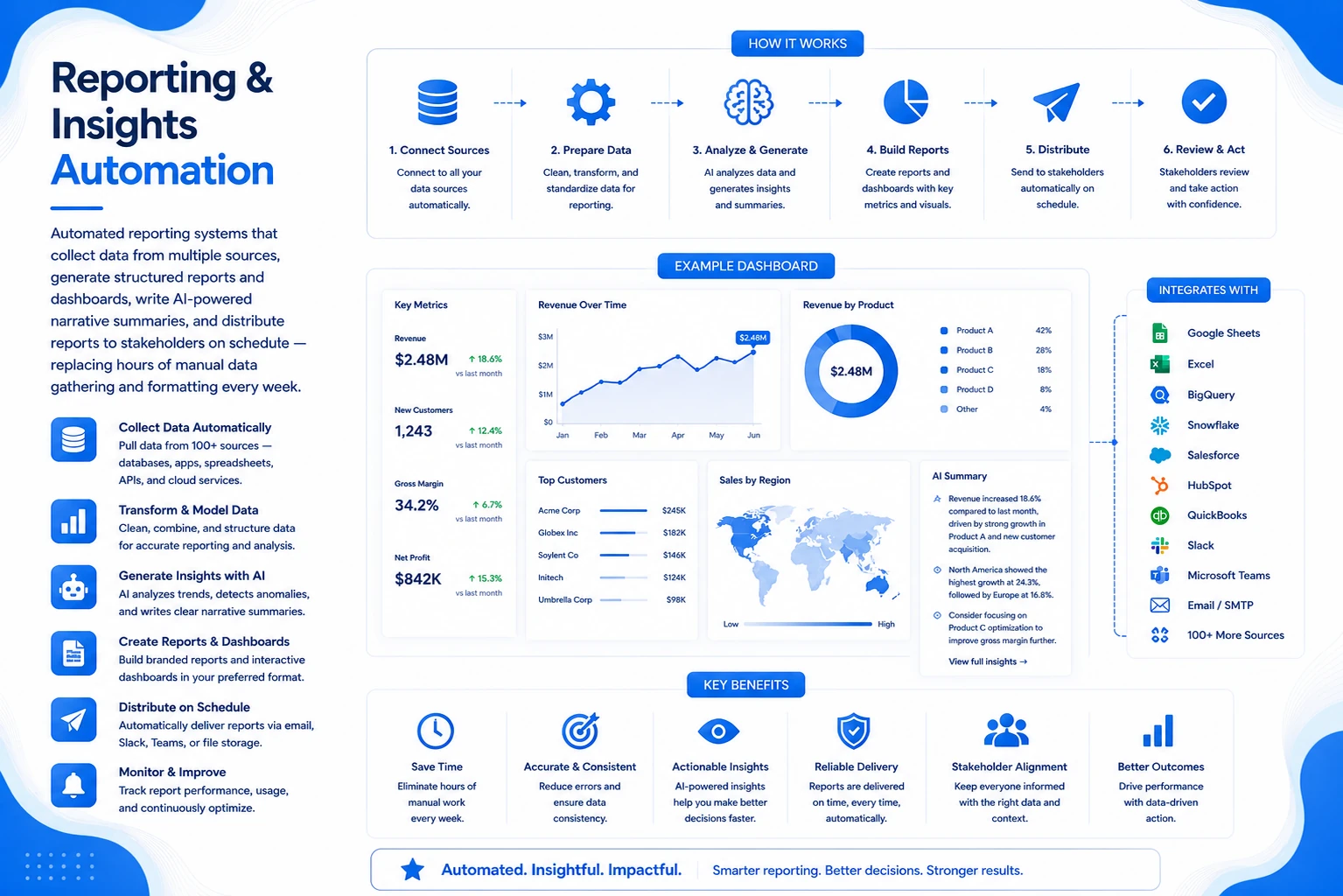
Reporting & Insights Automation
Reports that build themselves from your data, with plain-language summaries of what changed.
WITH AIAutomatic anomaly flags and written commentary.
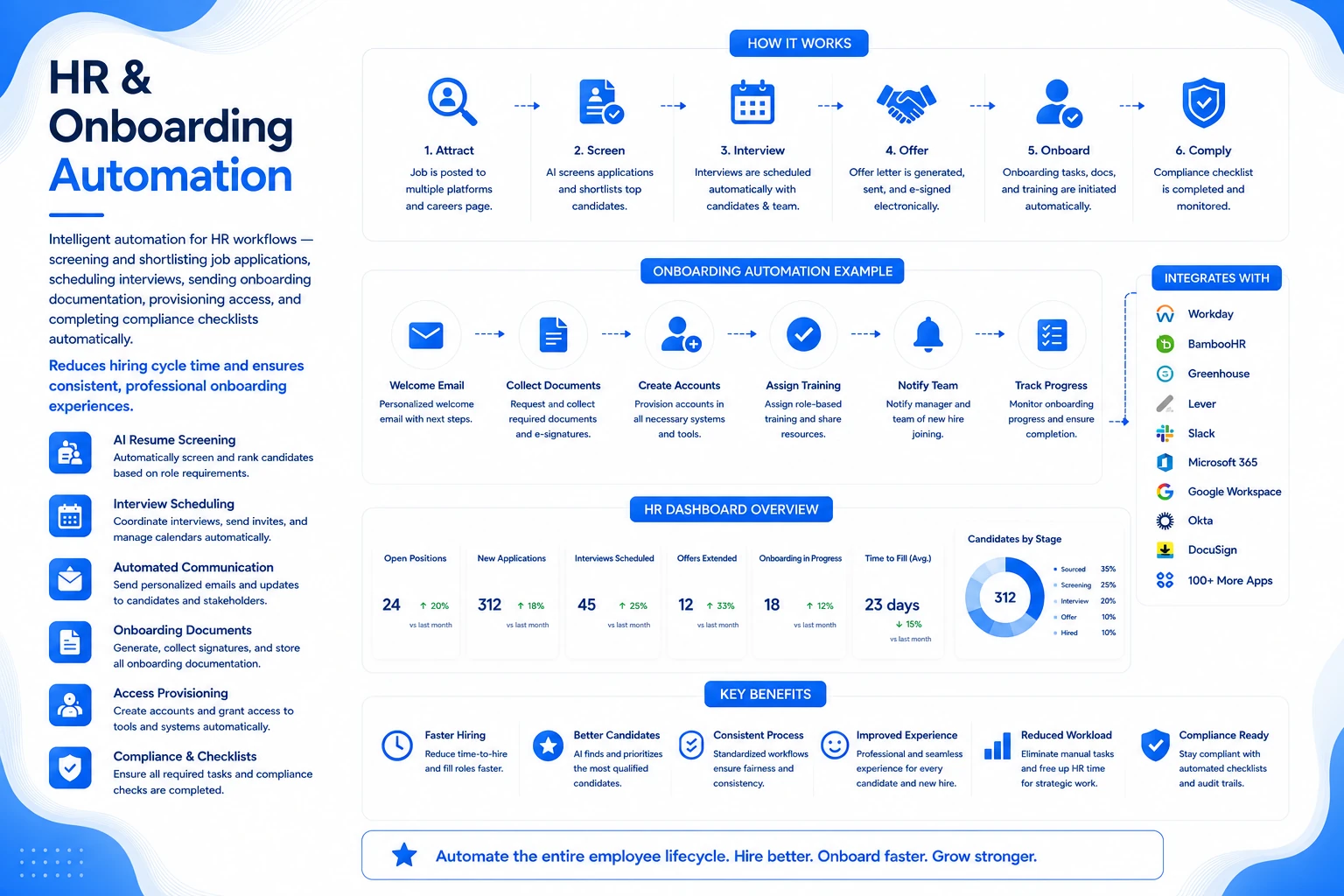
HR & Onboarding Automation
Candidate screening support, onboarding checklists, policy questions and leave workflows.
WITH AIPolicy answers grounded in your own handbook.
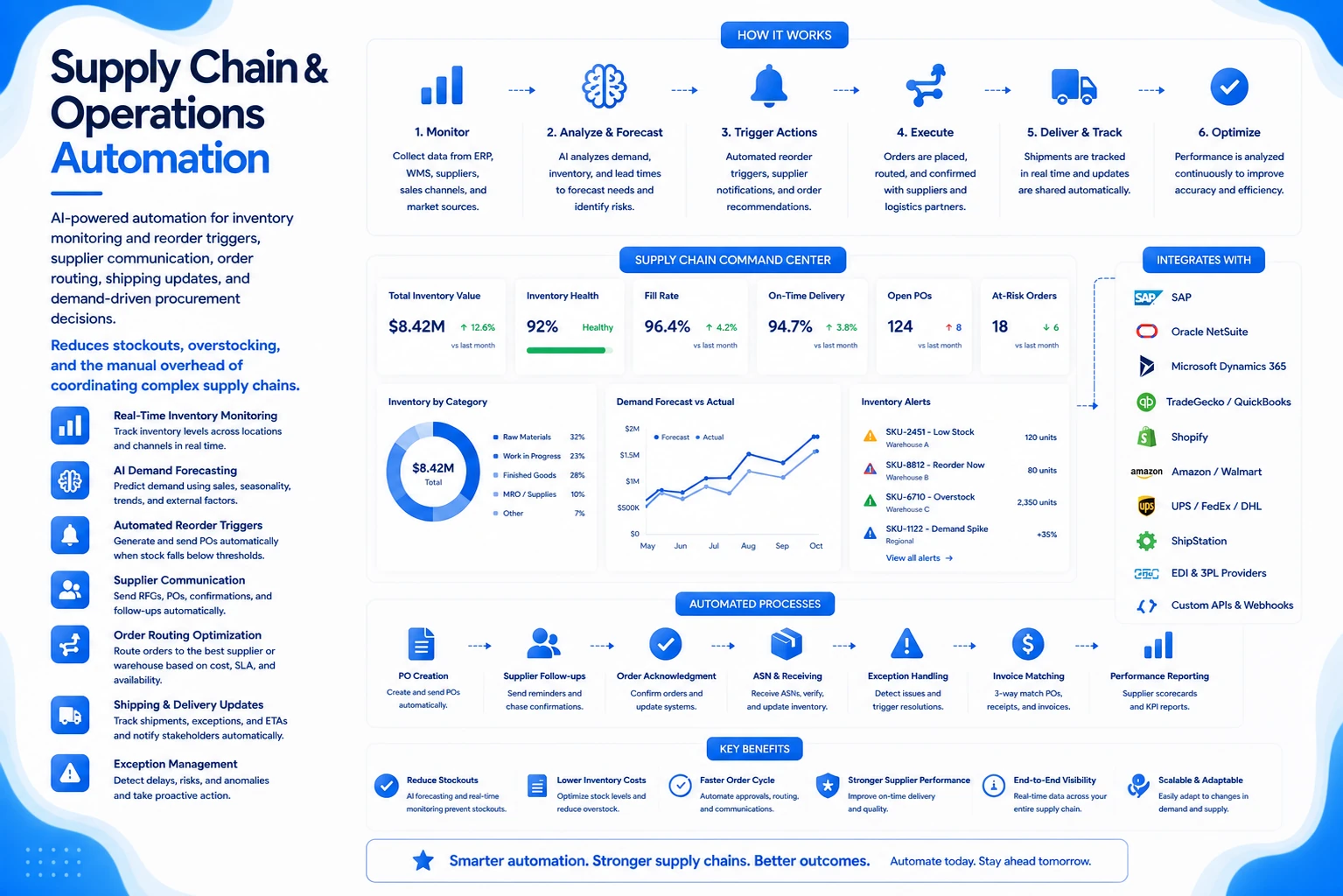
Supply Chain & Operations Automation
Order handling, stock alerts, supplier messages and exception management.
WITH AIEarly warning on delays and shortages.
How we work
From mapped process to monitored automation
Five steps that avoid automating the wrong thing.
Find the work
Map where people copy, check, chase and retype. Pick the processes with high volume and clear rules.
Process mappingMeasure today
Record time, errors and cost per case, so the benefit can be shown later.
BaselinePilot one flow
Automate one flow end to end with a review step, and compare against the manual result.
PilotAdd controls
Confidence thresholds, audit logs, alerts and a clear route for exceptions.
SafetyScale and tune
Extend to more flows, and use reviewer corrections to improve accuracy.
Improve
What we measure
Results you can show your board
Agreed before the build and reported after launch.
Built to be trusted
Controls in every automation
Automation should be safe to switch on and easy to supervise.
- Confidence thresholdsLow-confidence cases always go to a person.
- Audit trailEvery decision is logged with its inputs, for review and compliance.
- Safe on bad inputUnreadable or unusual documents are parked, not guessed.
- Access controlThe automation can only touch what it is meant to.
- Rollback planAutomated changes can be reversed, and a manual fallback exists.
- MonitoringVolume, accuracy and failures watched, with alerts to the team.
Automating across business systems?
Workflow and process automation connects ERP, CRM and approvals into one flow.
FAQs
AI automation questions, answered
AI automation uses models that can read text, documents and images, classify them and decide what happens next, then trigger actions in your systems. It handles work that traditional rule-based automation cannot, such as reading varied invoices or understanding emails.
RPA repeats fixed screen actions and breaks when layouts change or inputs vary. AI automation can understand free text and varied documents. The two are often combined: AI decides, and RPA or APIs perform the action.
High-volume, repetitive work with clear outcomes, such as invoice processing, email triage, onboarding, reporting and order handling. We rank candidates by volume, time per case, error cost and data availability.
The aim is to remove retyping, chasing and checking so people can do work that needs judgement. We design review steps so staff supervise the automation and handle the unusual cases.
It depends on the task and the data. We measure accuracy on your own examples before launch, set confidence thresholds and send uncertain cases to a person. We report accuracy openly rather than promising a number in advance.
The case goes to a reviewer with the AI suggestion attached. Reviewer decisions are logged and used to improve the system over time.
Yes. We connect through APIs, databases, email, file drops and, where needed, screen automation, so your current software keeps working.
A single well-defined flow usually takes four to eight weeks from mapping to a monitored pilot. More complex processes take longer.
We apply least-privilege access, encryption, masking of sensitive fields, audit logging and provider terms that fit your data rules. For stricter needs, models can run inside your own environment.
We record a baseline of time, errors and cost per case, then report hours saved, straight-through rate and turnaround time after launch.
Ready to automate the work nobody enjoys?
Show us a process that costs you time. We will measure it, test whether AI can handle it and tell you honestly what the saving could be.